TerraHawk
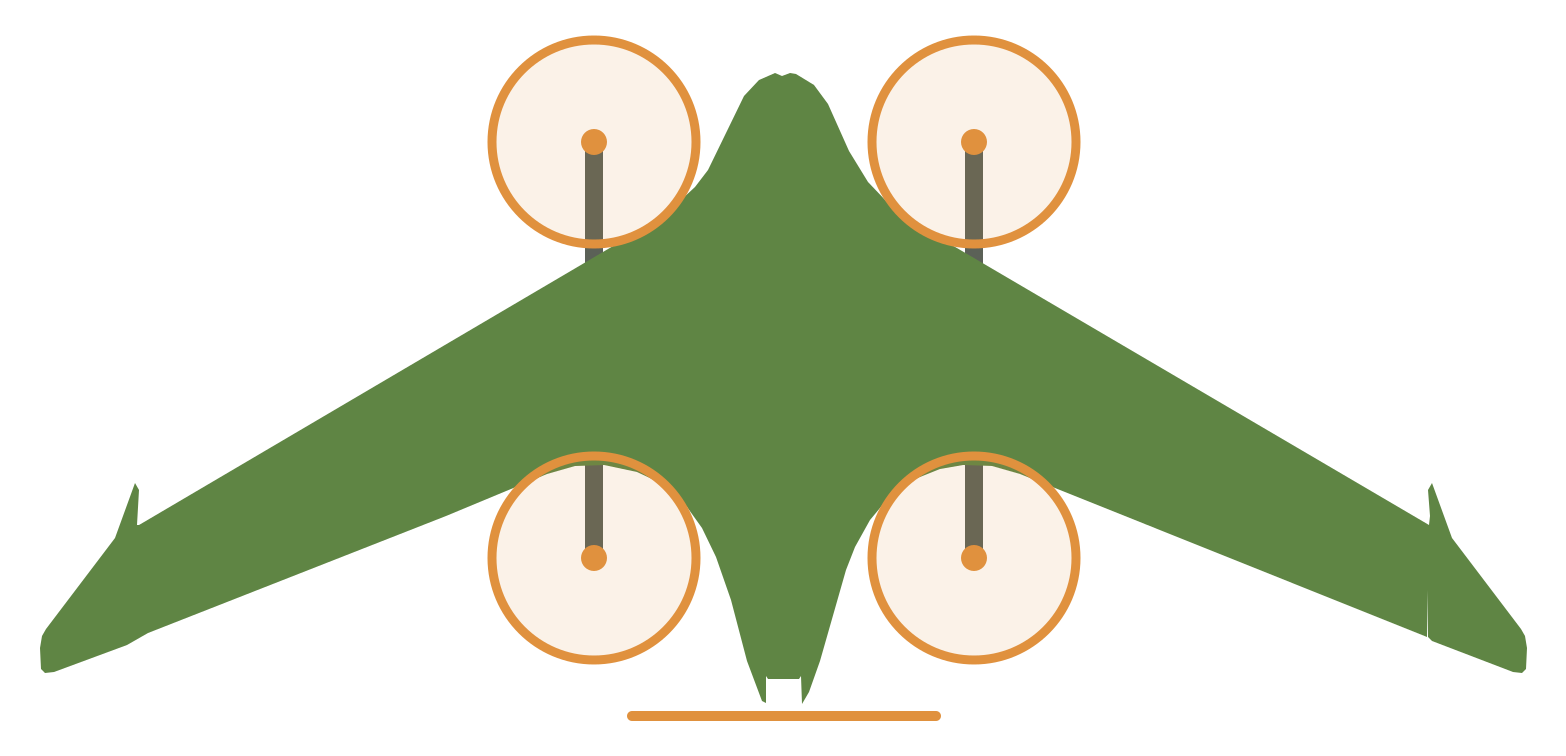
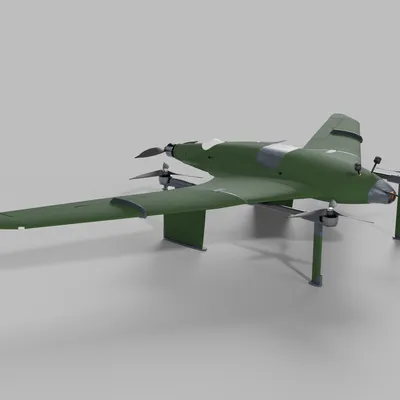
A 3D-printed 4+1 quadplane on 6S and ArduPilot. It takes off like a quad, cruises on a pusher and two elevons, and maps from a belly camera.
The aircraft
- Wingspan
- 1484mm58.4 in · 4 ft 10 in
- Length
- ≈648mmnose cone to the pusher motor; about 658 mm from the pitot tip≈25.5 in
- Height on its gear
- ≈233mmto the top of the spine radome≈9.2 in
- All-up weight
- ≈3.03kgFuselage C v2.4B, the first build, on keel B, with the P50B pack, Walksnail video and the nose package; no Survey3W and no night lights, as on the first flights. The Survey3W is not flyable on C as built (its nose trim exceeds the trim row). th-aeronautics' build-up (876a2e09, aa39a573), estimated until the balance≈6.7 lb
- Take-off and landing
- Verticalno runway, 4 lift motors
- Airspeed min / cruise / max
- 18 / 22 / 30m/sas set; held 19.6 or more in gusty survey turns and 20.0 or more in steady wind, with AIRSPEED_STALL 20.0 (SITL, 2026-10-01)40 / 49 / 67 mph
- Mapping per pack
- ≈255haFuselage C at 3,025 g, one 6S2P P50B pack at 21 m/s indicated and 116 m, lines across the wind, ending at the 45% low-battery trigger with the return covered; 249 ha in a 5 m/s crosswind, 240 at 8 m/s, 218 with the lines along an 8 m/s wind; 243 ha at night with the lights (th-aeronautics, ESTIMATE)≈630 acres
- A 100 ha (247 acre) survey
- ≈20 mintakeoff to landing on Fuselage C at 21 m/s indicated (17 min on the lines and turns), about 78 Wh to plan on, 36% of the pack's 216 Wh (th-aeronautics, ESTIMATE)
- Battery
- 6S10 Ah Li-ion recommended
This build
- Lift
- 4× EMAX ECO II 2807 1300KV8″ Gemfan F8041 folding, 3-blade (Ryan, 2026-10-08)
- Pusher
- EMAX ECO II 3115 640KVfixed APC 10×7E pusher
- Autopilot
- ArduPilotLumenier LUX F765 to fly first; our own H743 board later
- Payload
- MAPIR Survey3Wnadir, belly bay; not on the first flights
- ≈101 h · 1,136 gthe 35 Fuselage C v2.4B beds, drafted (th-main 295f4f76, bbac6e2e, 23f32856, 338b0b56; the blank payload cover on its own ASA bed, ac479f25; the spar mounts on g25, 6d2cdf72; the nose cone in ASA on g26, 8e0fab65; the part marks, 6100c988, and their support blockers, 55a69358; a brim on every PETG plate, 5ccf6b13; the trim bracket, df4f7c81; the Rear Arch on its own bed, g36; the Bay gate cut, 45662c74; the W169 Front, Hatch and VTOL cut, b2627382; and the W170 Spar Box, 6a34a3f5) released to print by Ryan on 2026-10-23, all but 16 LW-PLA beds (g01, g04 to g08, g18 and g27 to g35), which wait for their parts redrawn as one path a layer, or, for g04 and g05, the single-path VTOL Sections, for the proof load below (g10, the single-path Tail, is released, cut from th-blender's W160.4 with the seam at Y 565.5 and a spigot fit of 0.10 mm a side as printed; g03 and g36, the single-path Bay and Rear Arch, are released, cut from th-blender's W169 promotion, the Bay with its wing-root faces flat and no spigots or dowels, the spars locating them (Ryan, 2026-10-31), once every joint passed at 0.10 mm as printed, 2026-11-01; g20, the single-path Spar Box, is released again, cut from th-blender's W170 Spar Box, which Ryan chose (2026-11-02) because the W169 cut filled its internal dowel holes: each hole for the Q43 stack, the Beacon Carrier and the Landing Light Frame now prints round, about 1.94 mm, and is reamed with a 2.0 mm drill to about 6 mm deep at assembly; g02 and g09, the single-path Front and Hatch, are released, cut from th-blender's W169 promotion with one path on every layer and no retractions, 2026-11-01), with printed keys in place of the glue dowels, no infill and no solid layers, as on the single-path test parts (th-blender; Ryan, 2026-10-28). The PETG beds g15 (the canopy, cut flat at Y 333.3, the PETG Front Key, relieved at the Front pocket's mouth (W169.1), the beacon carrier, the charge bracket, the camera arm and the radio cradle base) and g12 (the plates and fences) are released with them. The PETG bed g25 (th-blender's W166 VTOL Spar Mounts, matched to the single-path VTOL Sections) and the TPU bed g14 (the seals, with th-blender's W163 Conduit Seals and their round 3.5 mm passage for the elevon leads as Ryan measured them) are released too (2026-11-01). The PETG bed g11 (the pusher motor mount, the wing clips and the lights parts) is released again, cut from th-blender's marked files with L03-A on the Landing Light Frame (Ryan, 2026-11-02; th-main af564576). After that, g06 and g07 print the proof-load wing once the single-path Airfoil Slice passes its peel test; g04, g05, g27 and g28 wait for that wing's proof load to 100 %, 32.2 N (3.5 g at the night build's 3,274 g, th-aeronautics); and g18 and g31 to g35 wait for the jack grip coupon and its fit and the keel jack bays (th-blender W131)
- Print, grouped
- 4.4days on the Core One+, home all day, with the elevons on the Kobra Max alongside (5.3 on workdays)
Select mission
Section titled “Select mission”- TutorialFrom STL pack to maiden flightThe whole build in the order it happens, with a check at the end of each stage.
- How-toPrint on a Core One+The manual's Bambu profile translated to PrusaSlicer, and the traps it hides.
- ReferenceParts list, 6S cartEvery part with price, reason and link, plus the 4S alternates and the mapping payload.
- ExplanationThe hangarA roll-off dock where the aircraft lands on a split-polarity pad and charges through its feet.
On the bench
Section titled “On the bench”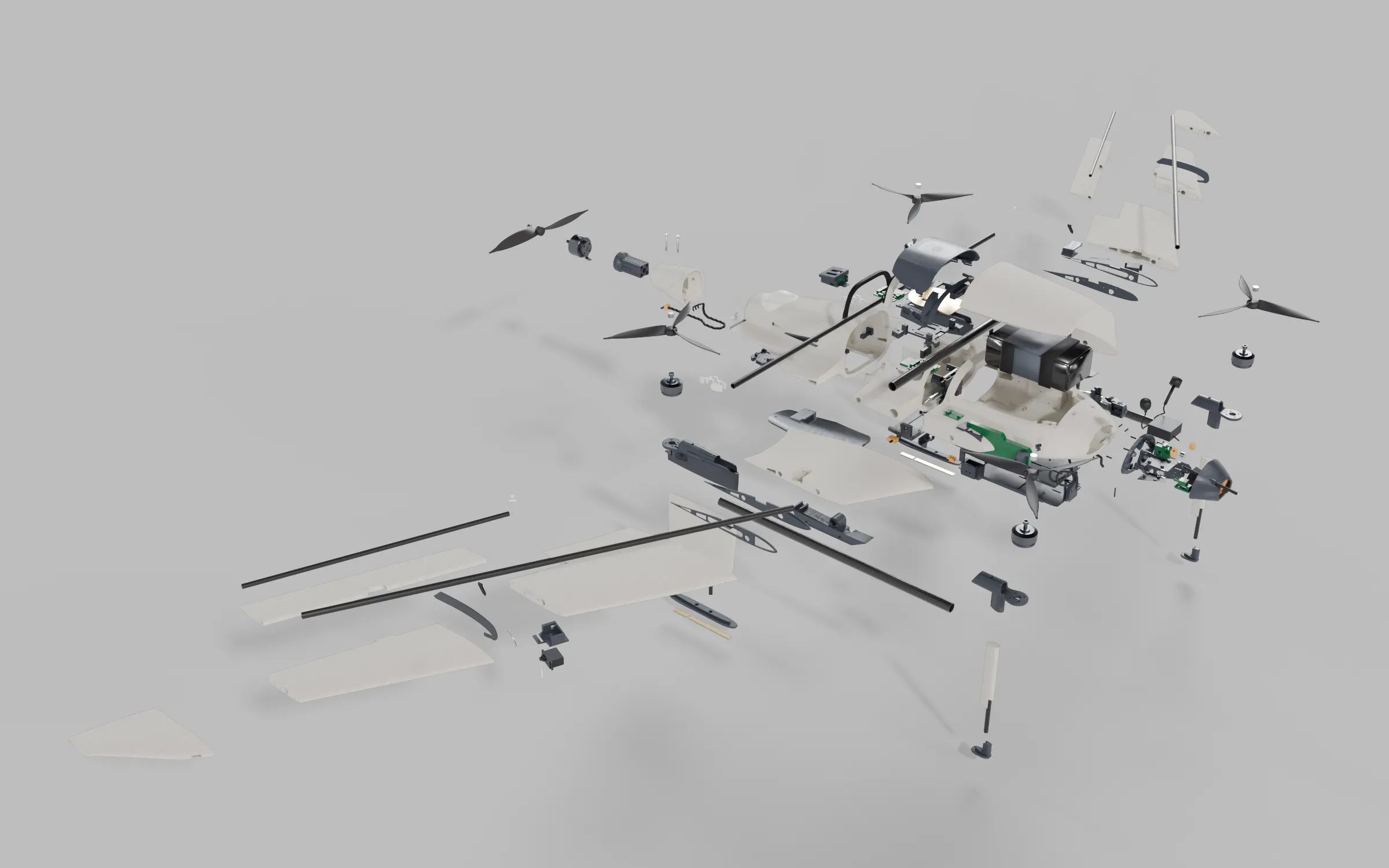
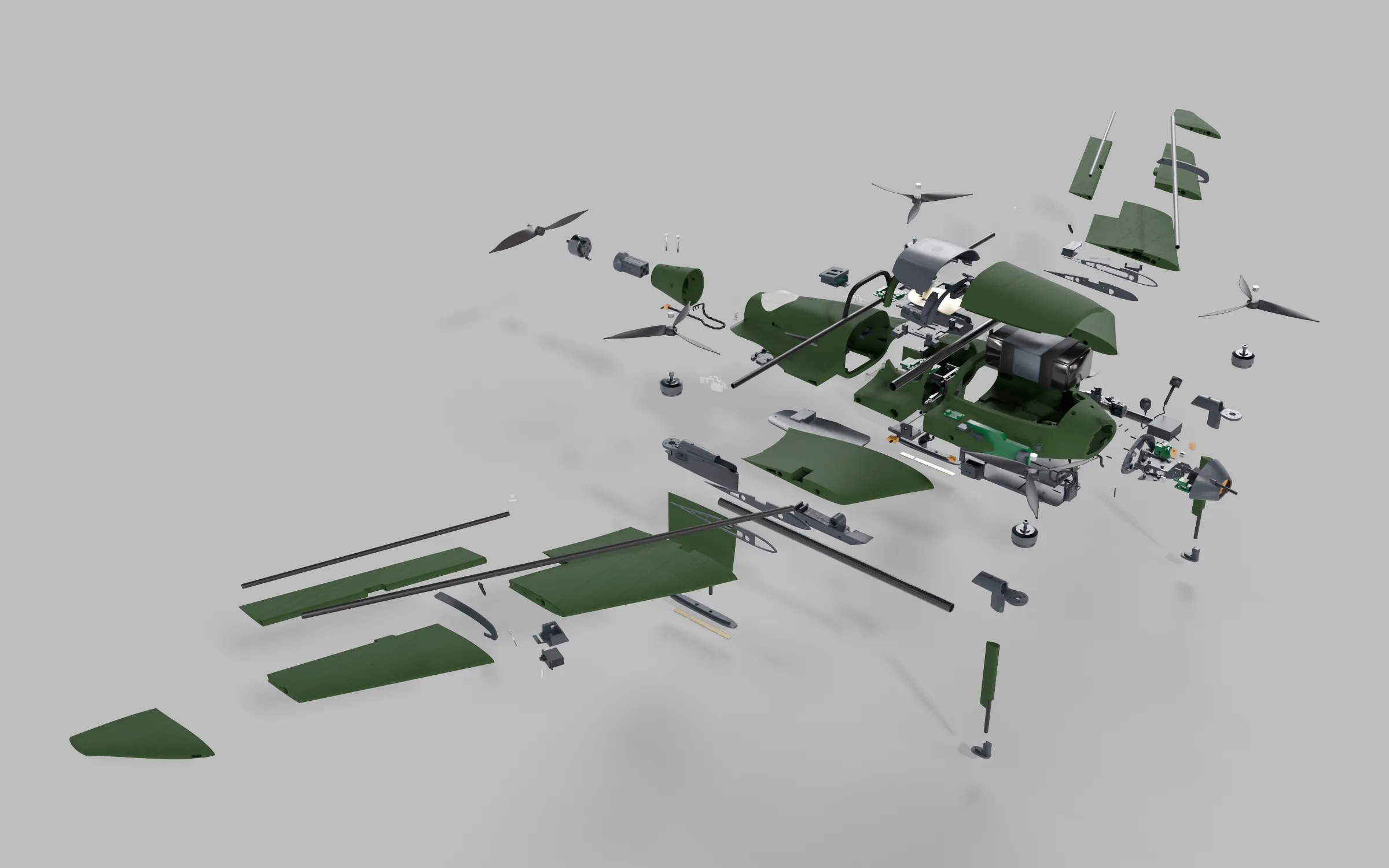
The first build pulled apart along its spars on keel B: the Fuselage C v2.4B shells, canopy and hatch, the pack on Battery Tray B and the CG trim slider, the Lucid on edge in its bracket, the Avionics Plate with the LUX, the Q43 seat, hub A with its two Micro BECs, the M10 on its hanger, the nose package (the brass total tube in the cone unit, the camera 15° down, W104), and our own-section wings with their fences at X 445, the elevons and the tips, each on its own line. The interior comes from the first build's parts ledger (th-blender W66, W73, W127.2, W133). The Nose Cone is ASA and is drawn dark (th-blender W145). The Trim Bracket and the nose cup are empty, as the day build flies: the slider reaches 268 mm with no trim (th-aeronautics 5f3c0135; th-blender W188, W199). 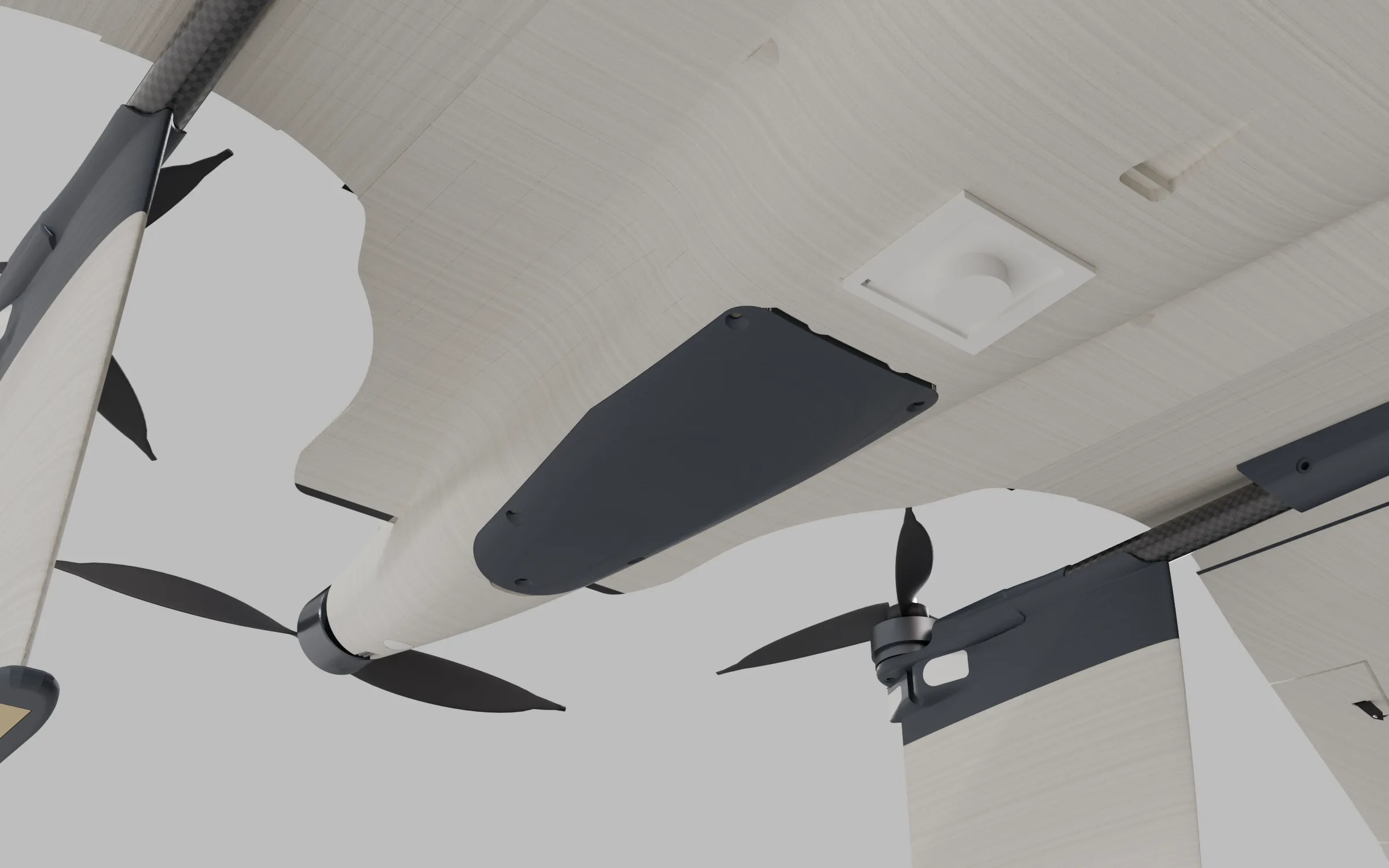
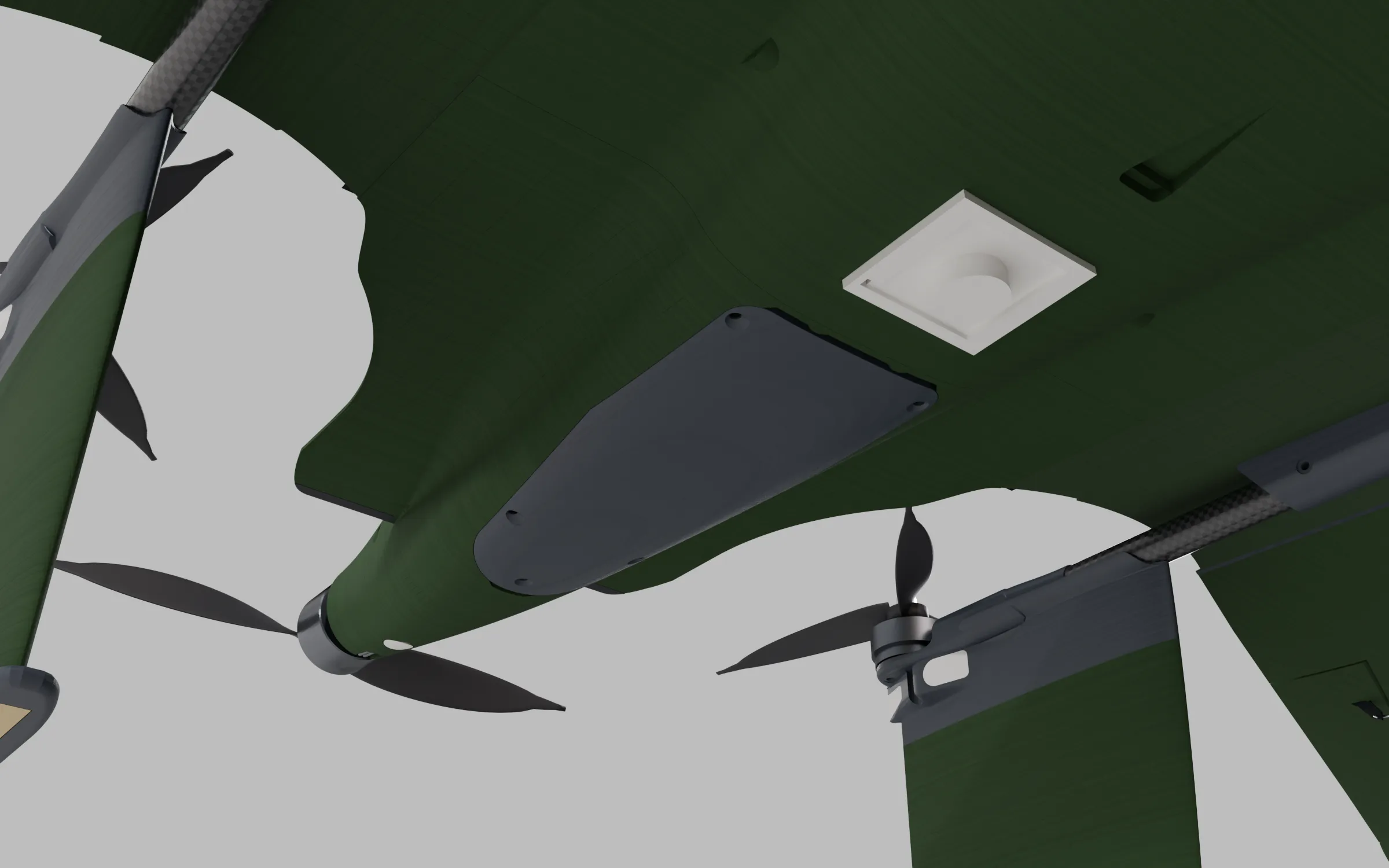
From below and behind: the belly bay of Fuselage C v2.4B under its blank payload cover, held by countersunk M3 screws (no Survey3W on the first build), with the APC pusher, keel B's rear keels and the rear lift props (th-blender W66). The front stilt mount's root groove is faired (W138). 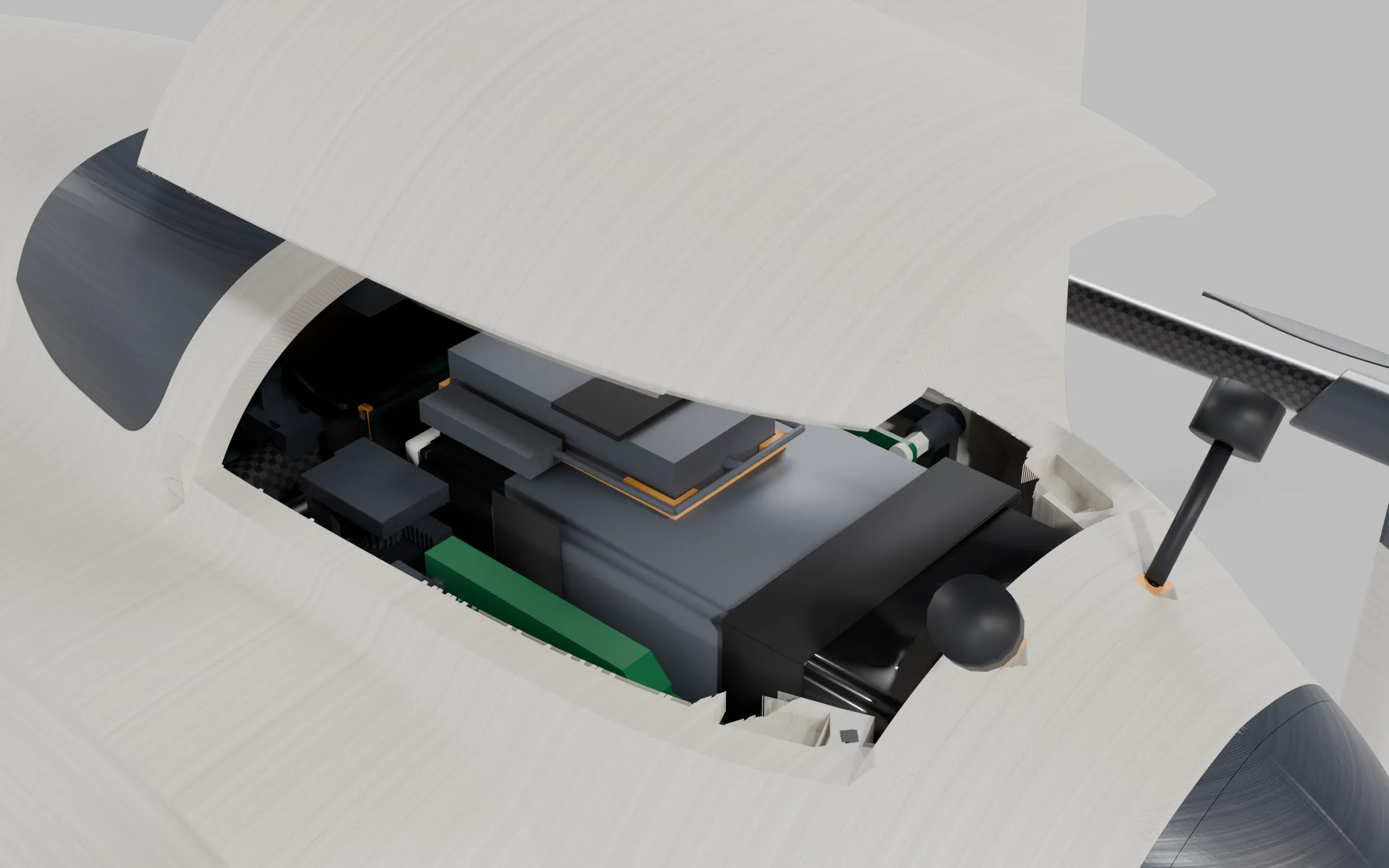
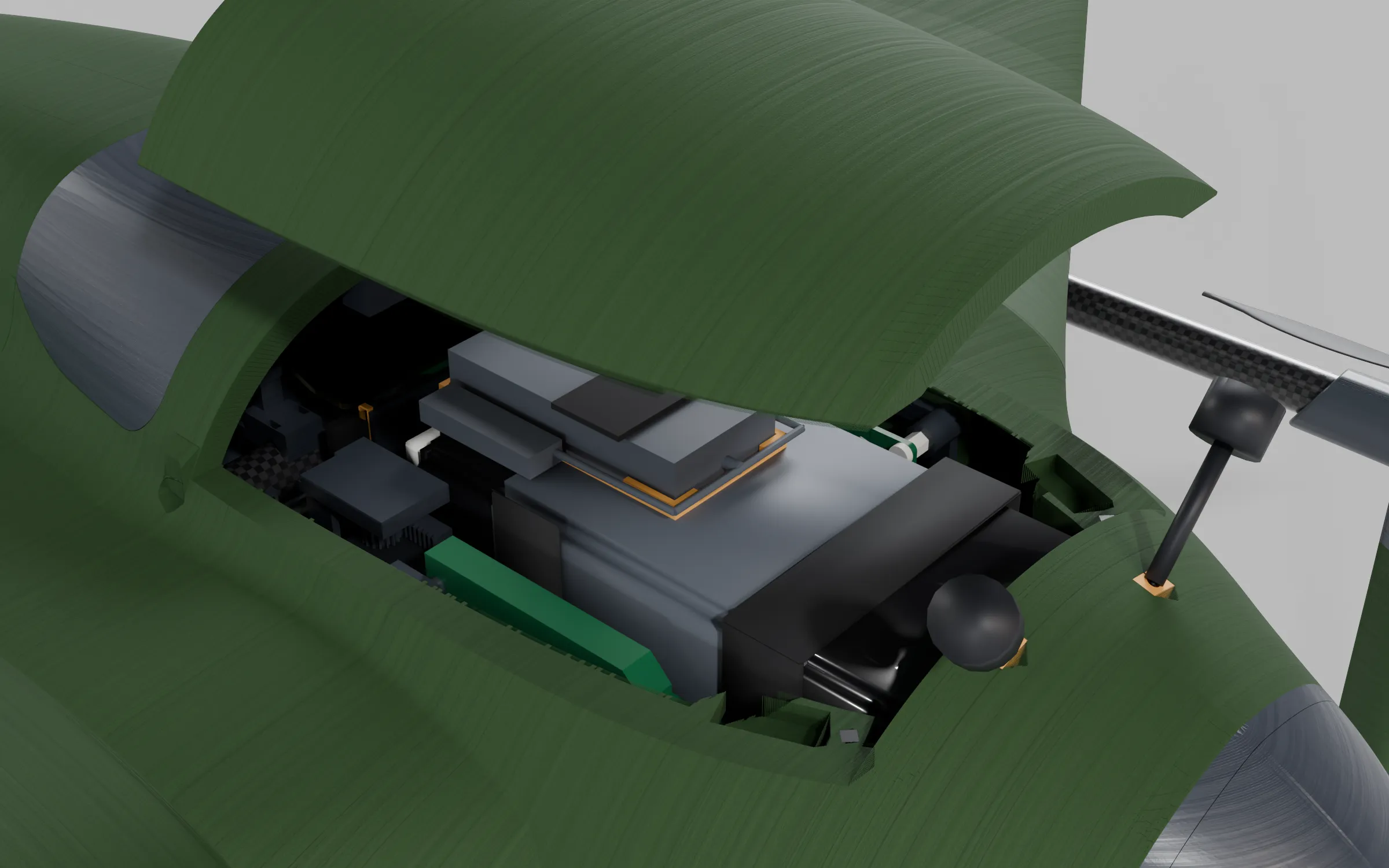
The Fuselage C v2.4B Hatch lifted over the pack bay: the 6S2P P50B pack on Battery Tray B, with the lighting battery on its saddle on top, the leads past it. Ahead of the opening, the starboard video antenna stands in its new notch on the roof, its head toward the camera, and the port antenna stands in the nose ring's notch beyond it (th-blender W127.1). The starboard antenna's grommet sits in its roof notch; the Front's old notch beside it is closed (th-blender W133). The Hatch's block magnets are not drawn here (th-blender W66).
Every render, airframe to hangar, is in the gallery.
Videos
Section titled “Videos”Background on printable VTOL quadplanes and survey mapping, from the Pathfinder series on YouTube.
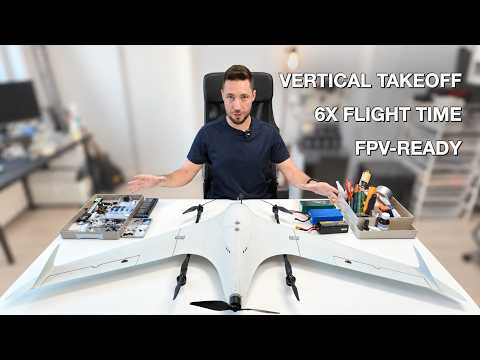 14 minI Designed A VTOL Drone Anyone Can 3D Print & FlyWhere the design started: a VTOL quadplane that prints at home.
 40 minI Tried Building a Mapping Drone for Large-Scale PhotogrammetryThe mapping role this build is set up for: RTK, a survey camera, processing.
 13 minHow do Autonomous VTOL Drones Work? QuadPlanes ExplainedHow a 4+1 quadplane hovers, transitions and cruises.
Logbook
Section titled “Logbook”b79f922bg20's hold names th-blender's W192.18, the smooth blister Ryan chose for the two fairing strips under the rear spar bores (2026-11-15, to th-blender): two strips with ribs behind each saddle, a 1.2 mm plateau blended at 2 to 3 deg forward and spanwise and about 9 deg aft. W192.17 did not smooth them and is not cut. Lint gate exit 0, YAML parses, MDX compiles513dd92eW192.17 (review): the Spar Box's two rear fairing strips (W192.12/13, 0.65 mm under the rear spar bores on layers 373 to 397, sides 24.6 deg) spread into one fairing over Y 316 to 340 and abs(X) 76 to 126 (Ryan, 2026-11-15, in Blender: no ridge; th-aeronautics' conditions). Not the 2 to 3 deg bump: the 0.95 LW band behind the saddle pocket may grow by 0.27 and stay one bonded band (a one-perimeter run of 1.25 to 1.49 prints two 0.45 beads with air, measured on this job's cuts; two strips start at 1.49), so under the pocket the surface follows the chord within 0.27 and keeps two 0.3 mm shoulders (21 deg mean), with gentle ramps either side (1.3 deg forward, 4.7 deg aft to the A2 face). Built by class: the skin band shifted whole on the pocket-free layers, the strips scaled on the deep end layers, W192.11's bottom_side re-planning the strip layers; the section inboard of the X 69 rib stays W192.16's. 118 layers. 270 of 270 one-path layers one run, no retraction, changes 0.204 or less; 33 solid layers change runs. Layer 1 identical; layer 422 the same beads re-fitted, the bond plates rebuilt the promoted ones with W192.15's margins. Saddle supports 11.5 mm (W192.16 11.9, limit 26); the 1.25 to 1.53 gap bands fall from 410 to 67 mm of wall; J2 feet identical, root face flat to 0.0248. g20 9 h 17 min 26 s, 77.09 g, toolpath 76.25 g at (0.02, 291.38, 2.07) (W192.16 9 h 16 min 40 s, 77.02 g, 76.17 g). Depth map before and after in parts/review. Post-slice checks three at a time under 6 GB caps (18 min against about 32 min). Nothing promoted9bec67b8g20's hold: until W192.17 is promoted, the page's file is the W192.16 cut and is not to be printed, in place of "on the bed meanwhile", which could read as on the printer (th-docs-site). Lint gate exit 0, YAML parses, MDX compiles5a87f16bg20's hold names th-blender's W192.17: Ryan chose to blend the two fairing strips under the rear spar bores into one broad fairing, about 30 to 40 mm chordwise at 2 to 3 deg, 0.7 mm deep, fading before J2 (2026-11-15, to th-blender; th-aeronautics recommends it). Lint gate exit 0, YAML parses, MDX compilesedfa4383Ledger regenerated on main: the Spar Box row's last-written commit is 728e5eb7 (the W192.16 promotion), not the worktree-side 1c5efb29 the promotion run saw. parts_ledger --check exit 066732070g20 re-cut on the promoted W192.16 Spar Box (728e5eb7, Ryan 2026-11-15: both cavity-wall pockets filled) and held: 9 h 16 min 40 s, 77.02 g, its extrusion as th-main's checked scratch cut on all 422 layers, the 270 one-path layers one run with no retraction, layers 1 and 422 as W192.15's, the Front Key in its channel a median 0.158, never under 0.124. Held for Ryan's decision on the two fairing strips under the rear spar bores (2026-11-15, to th-blender). The schedule row notes the front solid block's intended infill. Lint gate exit 0, YAML parses, MDX compiles1d0f6e82Spar Box jack pockets off at the source (Ryan, 2026-11-15): fuselage_c_parts cuts no jack reliefs or blind plug pockets in the Spar Box unless --jack-pockets, and single_path_w192_1 defaults to --jack=none728e5eb7W192.16 promoted (Ryan, 2026-11-15: "Promote, and fix the source"; the source fix is a separate job): parts/Fuselage C v2.4B Spar Box.stl 1bb2d454 -> 65f00209 (sha256 625db5c0 -> 68cb3860), byte for byte the W192.16 review file th-aeronautics and th-main checked. The .folds.json keeps W192.15's 66 keys: each reads the same edge distance on both meshes (largest change 0.0) and lies in air; its part and writer set; fold_check on the W192.16 cut exit 0, J2p 4.35 (2.65), J2s 4.95 (3.30). Ledger: the Spar Box's generator promote_w192_16.py promote, its note with the jack pockets gone and the Beacon Carrier's CAB.011 jacks not fittable; the Spar Box's rows carried onto HEAD's files, references as HEAD's. parts_ledger --check and part_marks --check exit 0. Saddles, bond plates, modifiers and seam line untouched
Comments
Comment on the whole page here, or on one section or step with the button beside it.