Prop and Wing Interaction
What the lift rotors and the pusher do to the wing in transition and cruise. The results come from DUST, a vortex-particle solver from Politecnico di Milano, run on the same measured wing as Wing Aerodynamics. Analysed 2026-09-26 at 2.25 kg.
The short version: in transition the lift rotors push the nose down by about 0.35 N·m. They also cut the wing’s induced drag by 0.5 to 1 N. Their effect on wing lift is small, because two large effects cancel. The pusher does nothing measurable to the wing.
Why DUST
Section titled “Why DUST”VSPAERO modelled the rotors as actuator disks too, but it failed a basic check. It showed the same lift loss with the rotors at almost no thrust. DUST sheds real vortex particles from each disk. The wake is free to move with the flow and reach the wing, which is the question here.
The wing is a vortex lattice, the same kind of model VSPAERO uses. In a first check at 20 m/s with no rotors, the two solvers agreed on the lift slope to 3% (4.33 against 4.21 per radian). DUST put the zero-lift angle 0.7° higher and the neutral point about 15 mm further aft, at 311 mm. So the neutral point is best read as a band from about 292 to 311 mm. The CG in the manual is stable anywhere in that band.
Where the rotor wakes go
Section titled “Where the rotor wakes go”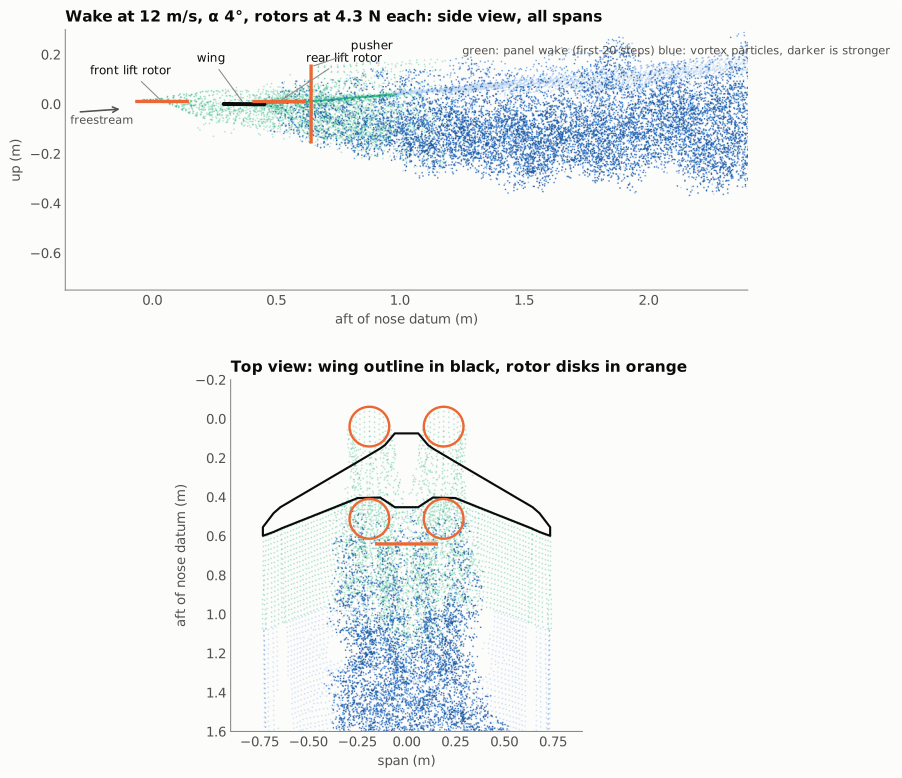
At 12 m/s the front rotors’ wake does not drop under the wing. It runs straight aft over the inboard wing and the VTOL sections, about 0.1 to 0.3 m from the centreline. The rear rotors then draw in that flow. The rear disks sit just behind the trailing edge and 10 mm above it. Their inflow pulls air over the aft part of the wing.
What the rotors do to the wing
Section titled “What the rotors do to the wing”In each case the lift rotors carry the weight that the wing does not: (weight − wing lift) / 4. The pusher gives 2.5 N. Each result is the rotors-on case minus a rotors-off case at the same speed and angle.
| Speed, angle of attack | Thrust per lift rotor | Wing lift, rotors off | Change in pitch about the CG | Change in wing drag | Change in wing lift |
|---|---|---|---|---|---|
| 8 m/s, 4° | 5.0 N | 2.1 N | −0.33 N·m | −1.05 N | +0.8 N |
| 12 m/s, 4° | 4.3 N | 4.8 N | −0.37 N·m | −0.90 N | −1.4 N |
| 16 m/s, 4° | 3.4 N | 8.6 N | −0.36 N·m | −0.49 N | −0.4 N |
| 12 m/s, 8° | 2.5 N | 11.9 N | −0.21 N·m | −0.28 N | −1.2 N |
A negative pitch change is nose down.
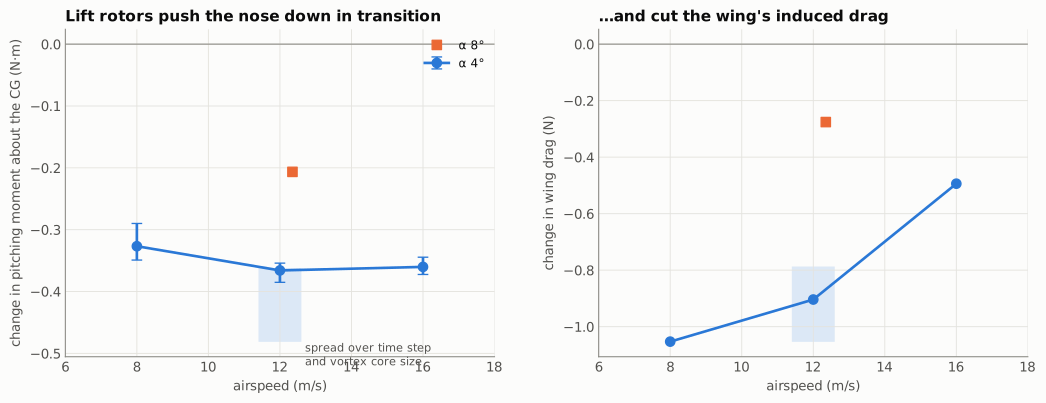
To see which rotors do what, the 12 m/s case was also run with only the front pair and only the rear pair.
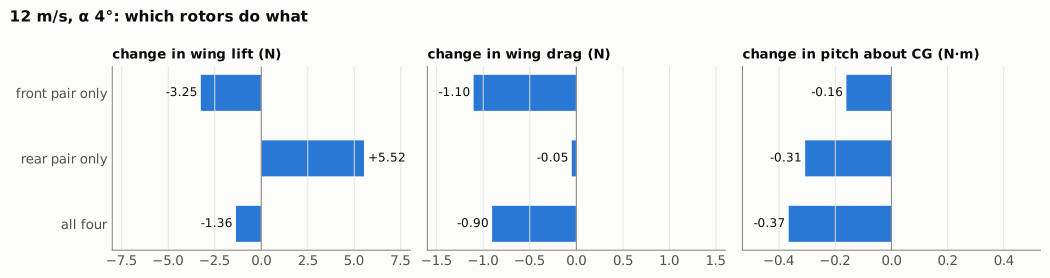
The front pair blows down on the inboard wing and removes about 3.3 N of lift. The rear pair adds about 5.5 N, because its inflow speeds up the flow over the trailing edge. The two do not simply add. With all four running, the rear rotors take in the front rotors’ wake, and the net change is small.
Both effects push the nose down. The lift that the front rotors remove is slightly ahead of the CG. The lift that the rear rotors add is well behind it. That is why the pitch result is steady and the lift result is not.
How far to trust the numbers
Section titled “How far to trust the numbers”The 12 m/s case was run again with a time step 20% shorter and 20% longer. It was also run with a vortex core radius of 20 and 40 mm instead of 30 mm.
| Result at 12 m/s | Spread over the five runs |
|---|---|
| Change in pitch | −0.36 to −0.48 N·m |
| Change in wing drag | −0.79 to −1.05 N |
| Change in wing lift | −1.4 to +1.9 N |
The pitch and drag changes are firm. The lift change is not: it changes sign with small changes to the settings. The honest statement is that the rotors change wing lift by less than about 2 N, which is less than 10% of the weight. Running the same case three times gives identical numbers to every digit, so the spread comes from the settings, not from random noise.
What it means in flight
Section titled “What it means in flight”The FC has to hold the nose up in transition. At 12 m/s it can do that with the lift motors: the front pair runs about 0.4 N (9%) harder than the rear pair. At 12 m/s the front lift motors then need about 480 gf each, well inside the 845 to 1125 gf window in Wing Aerodynamics. The elevons can share the load. At 12 m/s the moment equals about 8° of up elevon, and at 16 m/s about 4°. So expect the front lift motors to run warmer than the rear pair in transition logs, and do not read that as a fault.
The pusher does not change the wing. At 20 m/s it changes wing lift by 0.2 N and the pitching moment by almost nothing. The VSPAERO result that showed a large lift loss was an artifact.
Losing a rear lift motor in transition costs more than its thrust. The rear pair gives the wing extra lift. This is a prediction, not a measured result, but it is a reason to keep transitions short and above Q_ASSIST_SPEED.
Limits of this model
Section titled “Limits of this model”Each rotor is an actuator disk with even loading. There is no blade passage and no swirl, so the model shows the average wake, not the tip vortices of each blade.
The wing is a thin vortex lattice with the elevons at neutral. It has no body and no stall. It cannot model hover, because with no forward speed the wing sits in separated flow. A first hover case gave the wing an upward force of twice the rotor thrust, which is not physical. Hover download stays at the hand estimate in Wing Aerodynamics.
The model does not show how the pusher’s efficiency changes in the fuselage wake. A thrust stand test with the pusher behind a printed Tail Pusher would answer that directly.
How it was done
Section titled “How it was done”DUST 0.7.2 runs in a container built from the PoliMi source, tools/dust/Dockerfile. tools/dust_case.py writes one case from aero/geometry.json and the measured airfoils. tools/dust_matrix.py writes, runs and collects all 18 cases into aero/dust/results.json, in under an hour on 32 cores. tools/dust_report.py draws the figures.
docker build -t terrahawk-dust tools/dustuv run --with numpy python tools/dust_matrix.pyPYTHONPATH=tools uv run --with numpy --with matplotlib python tools/dust_report.pyTwo details are not in the DUST manual. The actuator disk traction is the disk’s total force in newtons, not a pressure (mod_actuatordisk.f90 divides it by the disk area). It acts along the positive disk axis, so a pusher in this frame needs a negative value to push forward.
Please cite DUST as: Tugnoli, M., Montagnani, D., Syal, M., Droandi, G. and Zanotti, A. (2021). Mid-fidelity approach to aerodynamic simulations of unconventional VTOL aircraft configurations. Aerospace Science and Technology, 115, 106804. The source is at public.gitlab.polimi.it/DAER/dust under the MIT licence.
Source: docs/dust.md in the repo. Edit it there; this page is generated.
Comments
Comment on the whole page here, or on one section or step with the button beside it.