Propulsion
A check of the lift motors and the pusher against published thrust-stand data, and a comparison with the kit’s recommended electronics. Analysed 2026-09-26 for the 6S build at 2.25 kg; hover and cruise figures updated 2026-09-28 for 2.59 kg with the keel A landing gear, the lift ESCs at the pods and the CG at 270 mm, again on 2026-10-01 for 2.75 kg on the 6S2P P50B pack at its 21.6 V nominal, and on 2026-10-06 for 2.85 kg, the first build as it flies (CG, 5856776).
The short version: the kit’s lift motors have far more thrust than the aircraft needs. The kit’s pusher prop, an APC 12x8, is too big for a 3115-class motor at full throttle. On 6S it goes over the V3115’s rating on a fresh pack, and on 4S it does so by a wider margin. A 10x7 fixes that and costs nothing in cruise. We fly it as an Aeronaut CAM Carbon Z 10x7 folding prop, modelled here with the APC 10x7E’s data.
Where the data comes from
Section titled “Where the data comes from”Three published sources, all measured, none of them ours:
| Source | What it gives |
|---|---|
| iFlight XING2 2809 test report | Current, power and thrust on 6S with an HQ 8x4x3 and a GF 7040, from 50% to 100% throttle |
| T-Motor V3115 test reports | Current, power, rpm, thrust and torque for all four KVs, 9 to 10.5 inch props, 4S to 12S |
| APC performance data | Thrust and torque for each APC prop against rpm and airspeed |
The manufacturer tables are published as images. They are copied by hand into aero/propulsion/motors.json. T-Motor’s 900KV table has typing errors of its own (“408.08 A” at 60%), so each row was checked for sense before use.
The model
Section titled “The model”Each motor is treated as a DC machine with three numbers. They are KV, the total resistance of the motor, ESC and wiring, and the current with no load. Each prop comes from APC’s tables. For a given pack voltage, the model finds the rpm where the motor torque equals the prop torque.
The T-Motor sheet sets the resistance. At full throttle on 6S the V3115 640KV draws 38.7 A at 11,405 rpm, which gives 0.146 Ω. The 8S point gives 0.160 Ω. The 8S point also shows that the motor gives less torque for each amp at high current. So the model reads a little low for current near full throttle. Treat its full-throttle currents as the least they will be.
Three independent routes agree to within 10 to 20%:
| Check | This model | Other method |
|---|---|---|
| Hover, four lift motors at 2.85 kg | 588 W, 27.2 A on the 2-blade; 628 W, 29.1 A on the 3-blade that flies (estimate) | 595 W, 27.5 A from momentum theory in Wing Aerodynamics |
| Cruise at 20 m/s | 118 W on the 10x7E, 122 W on the 10x6E | 3.6 N of trimmed drag from Wing Aerodynamics at 2.85 kg, on the fine CFD (3.4 N and 113 W at 2.75 kg until 2026-10-06; 4.0 N and 132 W on the VSPAERO drag before 2026-10-01). SITL’s pusher now reads its thrust and current from this model’s table (th-simulator 2fae5b0, 88645df): on the older drag th-testpilot’s H1 flew 129.8 W at 20 m/s, within 3% of this model on that drag |
| Lift motor thrust against power | model curve | iFlight’s measured points for the XING2 2809, the earlier motor, figure below |
Lift motors
Section titled “Lift motors”The kit recommends a 2807-class lift motor of 1050 to 1250KV on 6S with an 8-inch bi-blade prop. Our cart has the EMAX ECO II 2807 1300KV (Ryan, 2026-10-04; the iFlight XING2 2809 1250KV before) and the Gemfan F8041, which flies as the folding 3-blade since 2026-10-08 (Ryan; the 2-blade is kept to compare). The 3-blade is covered in its own section below; the figures in this section are the 2-blade’s unless they say otherwise. EMAX’s spec sheet (dated 2020-09-26) gives an internal resistance of 58 mΩ, an idle current of 1.3 A at 10 V, and a peak of 52 A and 1310 W on 6S, for 6 to 7 inch props; the model uses those since 2026-10-07. Until then it scaled the XING2’s resistance to the shorter stack, about 87 mΩ, which read the full-throttle current about 5 A low.
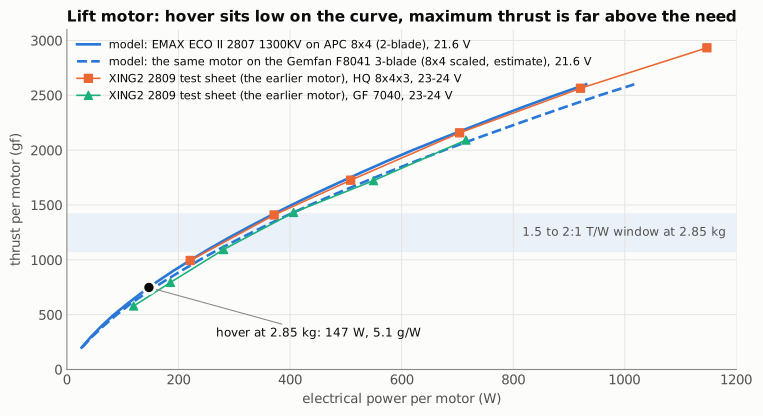
Hover takes about 49% throttle. At 2.85 kg each lift motor gives 748 gf for 147 W, 5.1 g/W (the XING2 gave 136 W, 5.3 g/W, at 2.75 kg). The four lift motors can give 2.6 to 3.4 kg each at full throttle. That is a thrust-to-weight ratio of 3.7 to 4.7, where 1.5 to 2 is the usual target for a VTOL. The kit’s choice is safe with a lot of margin. The margin is useful: in transition the front pair has to hold the nose up, as Prop and Wing Interaction shows.
The kit lists two 8-inch props. APC does not publish data for Gemfan or HQ props, so the nearest APC props stand in for them:
| Prop | Hover at 2.85 kg | Maximum thrust | Full-throttle current, fresh pack |
|---|---|---|---|
| APC 8x4, for the Gemfan F8041 | 147 W, 5.09 g/W | 2.6 to 3.4 kg | 53.7 A |
| APC 8x5, for the HQ 8x5 | 151 W, 4.96 g/W | 2.7 to 3.4 kg | 58.6 A |
| APC 8x4.5MR | 145 W, 5.17 g/W | 2.8 to 3.6 kg | 62.0 A |
For hover the choice hardly matters. At full throttle on a fresh pack the 8 inch prop takes the motor past EMAX’s ratings: about 53.7 A against the 52 A peak, about 1350 W against 1310 W, at about 23,100 rpm (tip Mach 0.72), because EMAX rates the motor for 6 to 7 inch props. ArduPilot never commands that: Q_M_SPIN_MAX (0.95 by default) caps the lift output, which gives about 49 A and 30.5 N a motor, inside the peak and still a thrust-to-weight of 4.4 at 2.85 kg. With the 2-blade, keep Q_M_SPIN_MAX at 0.95 or under (the 3-blade that flies needs 0.82, below); 0.90 gives 45 A with a thrust-to-weight of 4.0, if the thrust stand shows the motors running hot. The aircraft needs full lift thrust only briefly (a transition, a gust, a motor-out recovery), and hover is about 6.8 A a motor. The TBS Lucid 60A in our cart covers every case. These are model figures until the thrust stand; the prop’s own rpm limit is not published.
The 3-blade F8041
Section titled “The 3-blade F8041”a6f7307, 4 m/s from 240°, SITL's own Dryden gusts (seed 7). How it was flown, and the other films. Soundtrack, off until you unmute the player: Debussy, Clair de lune (Laurens Goedhart, piano, 2011; public domain), from Wikimedia Commons. Flown by ArduPilot; the logo on the title card is the project's own, used under CC BY-SA 3.0.On 2026-10-08 Ryan chose the Gemfan F8041 folding 3-blade for the lift motors. No 8-inch 3-blade has a published APC table, and APC’s own 2-blade and 3-blade pairs use different blades, so they cannot simply be scaled across. The F8041 3-blade uses the 2-blade’s own blade, three of them: Gemfan lists 11.6 g against 7.79 g, and the folding blades are sold singly. So the change is one and a half times the blade area on the same disc. A blade-element estimate with momentum inflow gives 1.27 times the thrust and 1.45 times the torque at the same rpm, with the figure of merit 1 % lower. The model scales the APC 8x4 table by those factors (THREE_BLADE in tools/propulsion.py). Two brackets: APC’s 11x7E against its 11x7E-3 (thrust 1.30, torque 1.38, merit 7 % higher), and a pessimistic case for blade interference at low Reynolds number (thrust 1.27, torque 1.54, merit 7 % lower). iFlight’s measured HQ 8x4x3, an 8-inch 3-blade on the XING2 (orange in the figure above), sits on the 2-blade’s curve, so the efficiency loss is more likely small than large.
| Fresh 25.2 V pack, 2.85 kg | 2-blade | 3-blade (central) | 3-blade (range) |
|---|---|---|---|
| Full throttle, no cap | 53.7 A | 63.9 A | 62.5 to 65.7 A |
Q_M_SPIN_MAX that holds 49 A |
0.945 | 0.84 | 0.82 to 0.85 |
| Thrust-to-weight at that cap | 4.33 | 3.81 | 3.56 to 4.08 |
Hover thrust fraction (Q_M_THST_HOVER) |
0.242 | 0.275 | 0.258 to 0.295 |
| Hover, at the nominal 21.6 V | 6.8 A, 147 W a motor | 7.3 A, 157 W a motor | 6.7 to 7.8 A |
| Hover rpm | 11,300 | 10,000 | |
Q_M_THST_EXPO fit (full / nominal pack) |
0.41 / 0.44 | 0.31 / 0.34 | 0.29 to 0.35 |
The cap has to come down before the 3-blade spins at full throttle. Uncapped it draws about 64 A, past EMAX’s 52 A peak and the Lucid’s 50 A continuous rating (the TBS Lucid 60A 3-8S AM32 is rated 50 A a channel continuous, 60 A for 60 s and 85 A for 10 s; TBS manual, section 13.3, parts list row 2b). A Q_M_SPIN_MAX of 0.82, the pessimistic end, holds 49 A in every case until the thrust stand sets the real value. Under the same current cap the 3-blade gives about 12 % less top thrust than the 2-blade, because the current limit binds first. A thrust-to-weight of 3.6 to 4.1 is still far above the 1.5 to 2 a VTOL needs. Hover costs about 7 % more current (2 % less to 14 % more) at about 1,300 rpm less, which makes the hover quieter. Over a mission’s minute or two of hover that is about 1 Wh of the pack’s 216 Wh.
The 3-blade’s thrust curve is straighter against throttle, so the expo fit falls from 0.43 to about 0.33. Folded in cruise, the third blade adds about 25 cm² of wetted surface a prop in the wake of the VTOL spar and motor: an estimate of 0.02 N, 0.5 % of the cruise drag. The CFD so far has the 2-blade folded. The four props add 15 g at the rotor stations, which are symmetric about Y 276, so the CG moves less than 0.1 mm.
Pusher
Section titled “Pusher”The kit recommends a 3115-class pusher, 640KV on 6S or 900KV on 4S, and says that both turn the same APC 12x8. That is the one recommendation the data does not support.
T-Motor rates the V3115 640KV for 9 to 11 inch props, with a 60-second limit of 44.4 A and 1111 W. Its own tests stop at 10.5 inches. With the 12x8E on 6S the model gives 39.8 A at the P50B pack’s nominal 21.6 V, and 50.5 A and 1270 W on a fresh 25.2 V pack. The current stays over the limit at 10 to 20 m/s. A climb-out after transition can last longer than 60 seconds.
The 4S option is worse for current. With the 900KV on 4S the same prop draws 64 A on a fresh pack. That is more than the kit’s own 50 A minimum for the pack, from the pusher alone, before the lift motors add anything in transition.
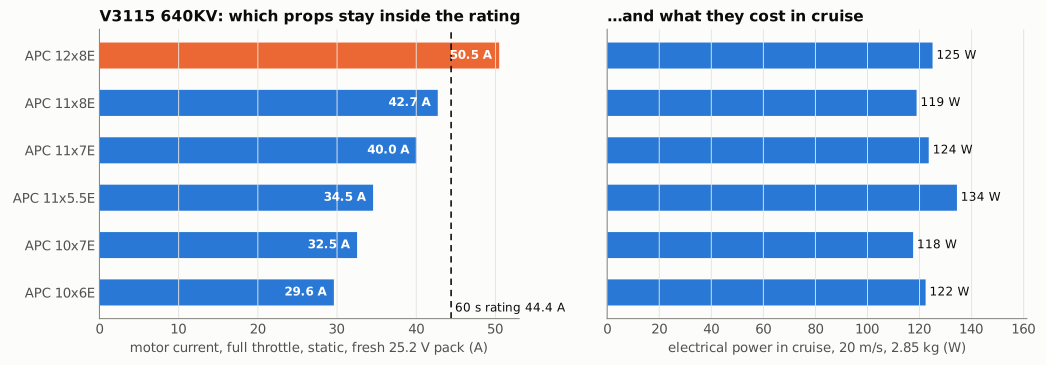
| Prop | Full throttle, fresh pack | Thrust available at 20 m/s | Cruise at 20 m/s |
|---|---|---|---|
| APC 12x8E, kit | 50.5 A, over the rating | 21.1 N | 125 W |
| APC 11x8E | 42.7 A, at the rating | 19.0 N | 119 W |
| APC 10x7E | 32.5 A | 15.2 N | 118 W |
| APC 10x6E | 29.6 A | 13.3 N | 122 W |
Thrust and cruise power are at the P50B pack’s 21.6 V nominal and 2.85 kg (2026-10-06; 2.75 kg from 2026-10-01); the full-throttle current is on a fresh 25.2 V pack.
Cruise at 20 m/s needs 3.6 N. Every prop in the table has nearly four times that or more, so none of them is short of thrust. The 10x7E stays well inside the rating and uses slightly less power in cruise than the 12x8E. It is the better prop for this motor on 6S. It needs a prop that turns the right way for a pusher, or a reversed motor direction. The kit describes the same choice for the 12x8. APC sells both rotations: the 10x7E (LP10070E) and the pusher 10x7EP (LP10070EP).
If you keep the 12x8E, limit the pusher with THR_MAX. The model puts the rating at 92% throttle. Because the model reads low near full throttle, 85% gives margin.
The chosen setup
Section titled “The chosen setup”Decided 2026-09-26. It is the cart in the parts list with one change, the pusher prop.
| Part | Choice | Reason |
|---|---|---|
| Lift motors | EMAX ECO II 2807 1300KV | Ryan’s choice, 2026-10-04, at less than half the XING2’s price: 4% more hover current; on EMAX’s published 58 mΩ about 54 A at full throttle on a fresh pack, 49 A at Q_M_SPIN_MAX 0.95 with the 2-blade (0.82 with the 3-blade that flies), inside its 52 A peak. The XING2 2809 1250KV before it was the only candidate with a published 8-inch test on 6S. The spare thrust holds the nose up in transition and gives yaw control in wind |
| Lift props | Gemfan F8041 folding 3-blade (Ryan, 2026-10-08) | About 7 % more hover current than the 2-blade, and it needs Q_M_SPIN_MAX near 0.82 to 0.84 to hold 49 A (estimate until the stand). Otherwise the same hover efficiency as the alternatives. The blades trail back when the lift motors stop, so they cannot park across the airflow, which costs up to 50 W in cruise |
| Lift ESC | TBS Lucid 60A 3-8S AM32 4-in-1 flies first (Ryan, 2026-09-29; the 60A model since 2026-10-04); the Vimdrones AM32 DroneCAN S50 at each pod, then our own pod board, is the later path | 50 A a channel continuous (60 A for 60 s, 85 A for 10 s) against the 49 A that Q_M_SPIN_MAX holds |
| Pusher motor | EMAX ECO II 3115 640KV in the cart (2026-09-27); the model uses the T-Motor V3115 640KV’s test data | The V3115 is the kit’s choice, with full test data, but it is sold out in the US. The ECO II has no 6S data, so the thrust stand gives its real current |
| Pusher prop | APC 10x7E (LP10070EP), fixed (Ryan, 2026-10-04); the folding Aeronaut CAM Carbon Z 10x7 on a bare 42 mm yoke stays an option | The 10x7E’s size on the numbers. The folding option lets a blade that touches something on landing swing away; see below |
| Pusher ESC | Hobbywing Skywalker 60A V2 | 33 A at most, so a large margin |
| Pack | 6S2P Molicel P50B, 10 Ah (Ryan, 2026-10-01; the Tattu 6S 4500 25C before) | 120 A continuous (Nexus, 60 A per cell, 2P; parts list row 13). Hover takes about 27.5 A at 2.85 kg, so a transition with the pusher at full throttle (25 to 33 A) peaks near 61 A, half the rating. The limit there is the PM02 power module, 30 A on its stock leads, which is why the parts list re-leads it in 10 AWG with an XT90. Sag at 61 A is about 2.7 V (estimate, 0.045 ohm) |
The smaller pusher prop gives up some acceleration and climb that the aircraft does not need:
| Pusher prop | 0 to 16 m/s in transition | Climb rate at 20 m/s |
|---|---|---|
| APC 12x8E | 1.3 s | 17.4 m/s |
| APC 11x7E | 1.5 s | 14.1 m/s |
| APC 10x7E | 1.8 s | 11.8 m/s |
The table is the first analysis’s (2026-09-26, lighter aircraft, 22.2 V). At 2.85 kg on the P50B’s 21.6 V the climb rates at 20 m/s fall to about 12.2, 9.7 and 7.9 m/s (12.7, 10.1 and 8.3 at 2.75 kg) for the three props, from the thrust and drag above (estimate); the 10x7E still climbs far faster than any survey needs.
The 11x7E is close, but its margin to the rating is 10%, about what the model can read low near full throttle. So the 10x7E is the safer choice.
APC limits its E props to 145,000 rpm divided by the prop diameter in inches. For the 10x7E that is 14,500 rpm. At full throttle on a fresh pack the model gives 12,900 rpm static and 13,400 rpm at 35 m/s. The limit is not reached in flight.
For rotation, fit the yoke and blades as a tractor prop would sit, with the blades’ front faces toward the motor, and reverse the pusher in the ESC. The blades then fold aft, away from the motor.
Why the prop folds. On the keel A landing gear (2026-09-27) the aircraft stands 168 mm below the datum, and the pusher’s axis is at the datum. A 10-inch blade that stops vertical reaches 127 mm below the axis, so it clears flat ground by 41 mm wherever it stops. A 12-inch blade clears by 16 mm. On the kit’s own feet, 48 mm below the datum, a rigid prop hit the ground on about three landings in four. The keel removes that, so the fold is margin, not a need: a tail-low touchdown, tall grass, a stone, or a hand in the hangar meets a blade that swings away instead of one that breaks or cuts. Ryan chose it on 2026-09-27.
A folding prop works on a pusher only when it folds aft, away from the motor. Seen from the airflow, that is the same as a tractor’s fold: the airflow folds the blades when the motor stops, spin opens them, and thrust holds them open. What does not work is a folding spinner, which is built for a tractor and folds its blades toward the motor. On a pusher that is forward, into the airflow, so the blades stay open or windmill. An earlier version of this page said no folding prop works on a pusher; that was wrong, and it was the spinner that could not work.
So the prop is a bare Aeronaut yoke with no spinner, and it needs three things that a tractor gets from its fuselage and spinner (ItsQv):
- A rear stop plate. Nothing behind a pusher stops the blades, so without it the tips fold past each other.
- A front stop plate, set just past the blades’ natural open position. Without it the blades find their own angle on each start, which shakes the prop.
- A light elastic band across the blade roots. The pusher is stopped in hover and on a vertical landing, where there is almost no airflow to fold the blades. The band folds them, so they are already folded at touchdown. Spin at start-up opens them against it.
The pusher ESC, the Hobbywing Skywalker 60A V2, needs its brake on, so the prop stops and folds instead of windmilling. The hinge moves each blade only fore and aft. A blade folded aft is out of the way of the ground. An open blade that is hit straight up its length does not fold, but the keel keeps that case 41 mm off flat ground.
The lift props need brake on stop. In forward flight the four lift motors are stopped, and the Gemfan F8041 blades fold back in the airflow. Without a brake the 20 m/s airflow windmills the stopped motors, the blades open again, and the aircraft flies with four spinning 8-inch props, which is the “props across the flow” drag case above. So set brake on stop in each lift ESC (AM32 firmware, the “brake on stop” option), not in the flight controller. Brake on stop shorts the motor phases only once the ESC has been told to stop, so it does not brake a spinning prop from speed.
Kit recommendations, side by side
Section titled “Kit recommendations, side by side”| Kit recommendation, 6S | What the data says | Action |
|---|---|---|
| Lift motor 1050 to 1250KV, 8-inch bi-blade | Thrust-to-weight 4.0 to 5.0 at 1250KV. Hover at 46% throttle | None |
| Gemfan F8041 or HQ 8x5 lift props | Same hover efficiency within 5% | Either |
| Lift ESC 45 A or more per channel | Full throttle reaches 49 to 57 A, but flight never needs it | A 60 A board, as in the cart |
| Pusher 3115 640KV with an APC 12x8 | Over the 60-second rating at full throttle | A 10x7, chosen, as a folding Aeronaut CAM Carbon Z. Or THR_MAX 85 with the 12x8, which clears the ground by 16 mm on the keel A gear |
| Pusher 900KV on 4S with the same 12x8 | 64 A on a fresh pack | Not our build. A smaller prop there too |
| Pack 120 A continuous | Not a limit | Our P50B pack is rated 120 A continuous (parts list row 13): a transition with hover and the pusher at full throttle peaks near 59 A (estimate). An earlier 50 A figure came from the kit’s minimum pack rating |
Limits
Section titled “Limits”The props are APC stand-ins for the Gemfan F8041, the HQ 8x5 and the Aeronaut CAM Carbon Z 10x7, which have no published data. The folding F8041 is probably a little less efficient than a fixed APC 8x4. The CAM 10x7 is rated on a 42 mm yoke; its current at full throttle is the first thing to measure.
The resistance for the XING2 is its published winding resistance plus the ESC and wiring share from the V3115 fit. iFlight’s sheet gives no rpm, so it cannot set that number directly. The close fit to iFlight’s measured points in the lift figure suggests it is near. The EMAX ECO II 2807 has no published test: its curve in the figure is the XING2 model with the scaled resistance, so the thrust stand is its first check.
The manufacturer sheets round the voltage to whole volts. The model uses power divided by current instead. ESC efficiency is taken as 95%.
To check on the thrust stand
Section titled “To check on the thrust stand”- The pusher with the CAM 10x7 at full throttle for 10 seconds on a fresh pack. Expect about 32.5 A, the 10x7E’s figure. It must stay under 44 A. Watch for vibration: if the prop shakes, adjust the front stop.
- The pusher stopped with the brake on: the elastic band must fold both blades aft with no airflow.
- One lift motor with the F8041 3-blade at hover thrust, 748 gf (2.85 kg): current against about 7.3 A at 21.6 V (6.7 to 7.8 A; the 2-blade, 6.8 A).
- One lift motor at full throttle with the duty capped at 0.82, then stepped up in 0.01 steps while the current stays under 49 A on a fresh pack: the highest step that holds it is the
Q_M_SPIN_MAXfor th-avionics (the model expects 0.84). Never run the 3-blade uncapped: the model expects about 64 A. Fit the thrust against duty on the same run forQ_M_THST_EXPO(the model expects about 0.33). - One lift motor stepped from a braked stop, blades folded, to hover throttle: the time to reach 90% of the 748 gf hover thrust. Over 1.0 s is reported to th-avionics and th-eda as an ESC finding. The stall-test card sets the recovery floor and the stop from the measured time, because in the simulator each extra second of spool-up costs about 22 m of height in the stall recovery. The folding blades add to it: they must swing out under centrifugal force before the rotor makes thrust, so log the step on a camera as well as the load cell.
How it was done
Section titled “How it was done”PYTHONPATH=tools uv run --with numpy --with matplotlib python tools/propulsion.pytools/propulsion.py reads aero/propulsion/motors.json and the APC tables in aero/propulsion/apc/, writes aero/propulsion/results.json and draws the figures in docs/propulsion/.
Work list
Section titled “Work list”- The pusher motor’s shaft: the EMAX ECO II 3115 in the cart has a threaded M5 shaft, 17.5 mm above the bell. An aluminium 5 to 8 mm bushing over the thread replaces the grub-screw adapter (row 6b of the parts list).
- When the motor and the yoke arrive: check that the stack (front plate, yoke, rear plate, flange nut) fits the 17.5 mm of shaft.
- th-main, when the blades arrive: measure how far the blade roots reach toward the shaft, open and folded, and set the stop plate diameters in
tools/make_pusher_stops.py. The plates inparts/are placeholders, marked “(PLACEHOLDER)” in their names, and are not printed until this is done. A wider fold angle wins back fore-aft landing window on the pad (th-hangar: ±118 mm now), but the folded blades must stay above Z -41 at any yaw (th-aeronautics). - th-main: add the stop plates to the PETG print beds after the diameters are set.
- Ryan: set brake on in the Skywalker 60A pusher ESC, and reverse its direction.
- Thrust stand: the two pusher checks in “To check on the thrust stand” above.
- Before the thrust stand, the one folding-prop experiment worth doing (th-aeronautics, 2026-09-28): one lift motor with its F8041 blades folded and the brake on, on a pole above a car at 20 m/s (72 km/h), filmed with a phone. Then repeat with a board held at 7 degrees just ahead of it, as the wing’s wake. The rear pods sit in that wake, and only hinge friction damps the blades, so buffet or partial opening is possible. If the blades stay folded and quiet, there is nothing to model.
- Thrust-stand pass marks (th-aeronautics): each lift motor at the 748 gf hover near 7.3 A at 21.6 V on the 3-blade (2.85 kg), inside 6.7 to 7.8 A (EMAX ECO II 2807 on its published 58 mΩ; 6.8 A on the 2-blade); the pusher near 29 N static and 32.5 A at full throttle on a fresh pack (about 25 A at the P50B’s nominal 21.6 V) (V3115 model data; the ECO II may differ). Inside those, the APC stand-in data holds.
- th-aeronautics: put the weighed prop mass into the CG page (estimate: 10 g over the 10x7E at Y 650).
Source: docs/propulsion.md in the repo. Edit it there; this page is generated.
Comments
Comment on the whole page here, or on one section or step with the button beside it.