Beacon block board: iso
Boards / beacon nets cut at the block boundary by tools/blockgen.py; bench header pins are the only addition
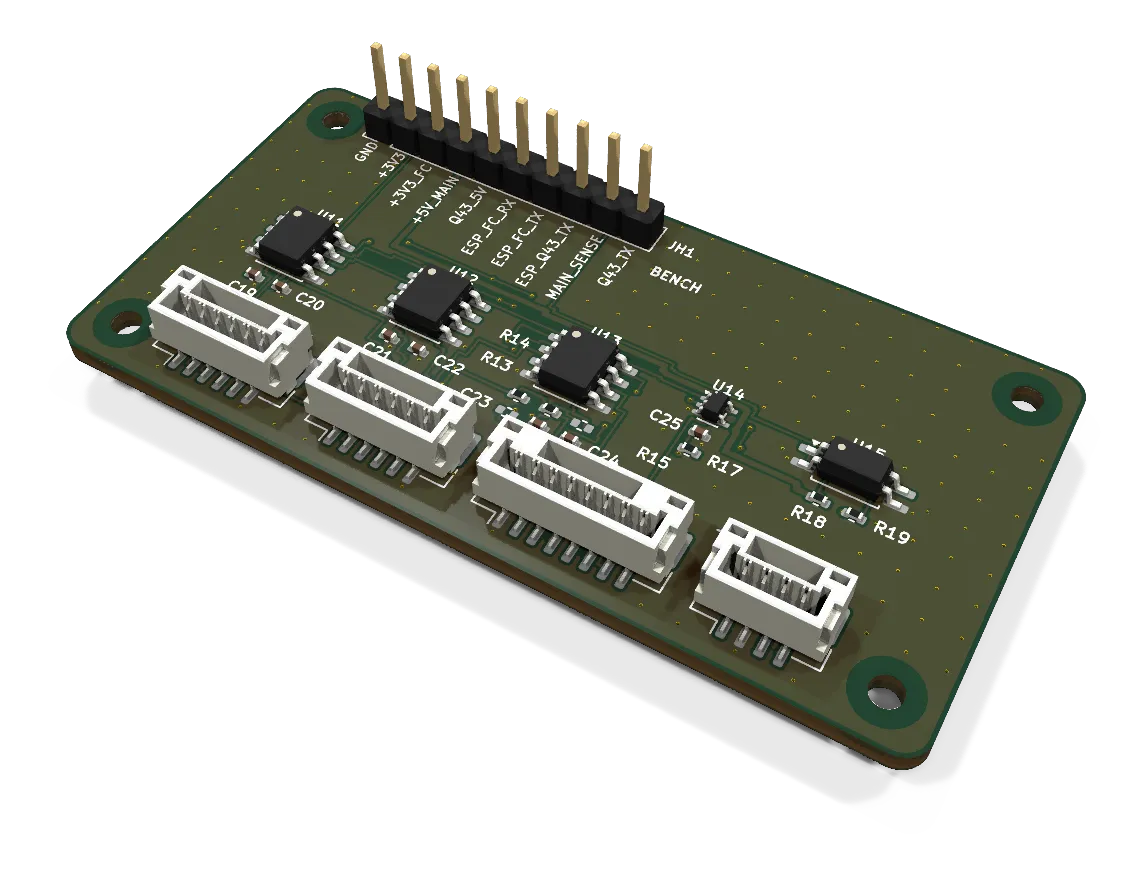
The beacon's isolator block on its own board, so the UART and I2C isolation between the flight controller and the always-on side can be proved against a real flight controller before the beacon is built.
- Revision
- A
- Sheets
- 1
- Parts
- 24
- Board
- 64 × 32 mm
- Copper layers
- 2
- Footprints
- 28
- Location
- bench
- Bus
- none: the beacon's own GPS1, TELEM2, airspeed and Q43 connectors on one side, a 10-pin header for the ESP32 side
- Status
- Rev A draft: routed, DRC clean (2026-10-10), not ordered
What it does
This is a bench board, not an aircraft part. It carries the beacon’s iso block exactly as it is on the beacon: the two ISO7721 isolators on the GPS and radio UARTs, the ISO1541 on the compass I2C, the EL357N optocoupler that senses main power, and the 74LVC1G08 gate that lets the flight controller and the ESP32 share the Q43’s receive line. Its purpose is to show the isolators passing data the right way with the flight controller’s side powered by the flight controller and the always-on side powered from the bench, which is the one property of the beacon that the schematic checker cannot see (a review found both UART isolators drawn with the sides swapped before the beacon was routed).
The board is cut out of the beacon’s design data by a tool rather than drawn again, and every net on it is checked to be the beacon’s own net, pin for pin, with only the header pins added. So what the bench proves is the beacon’s circuit, not a copy of it.
Where it sits
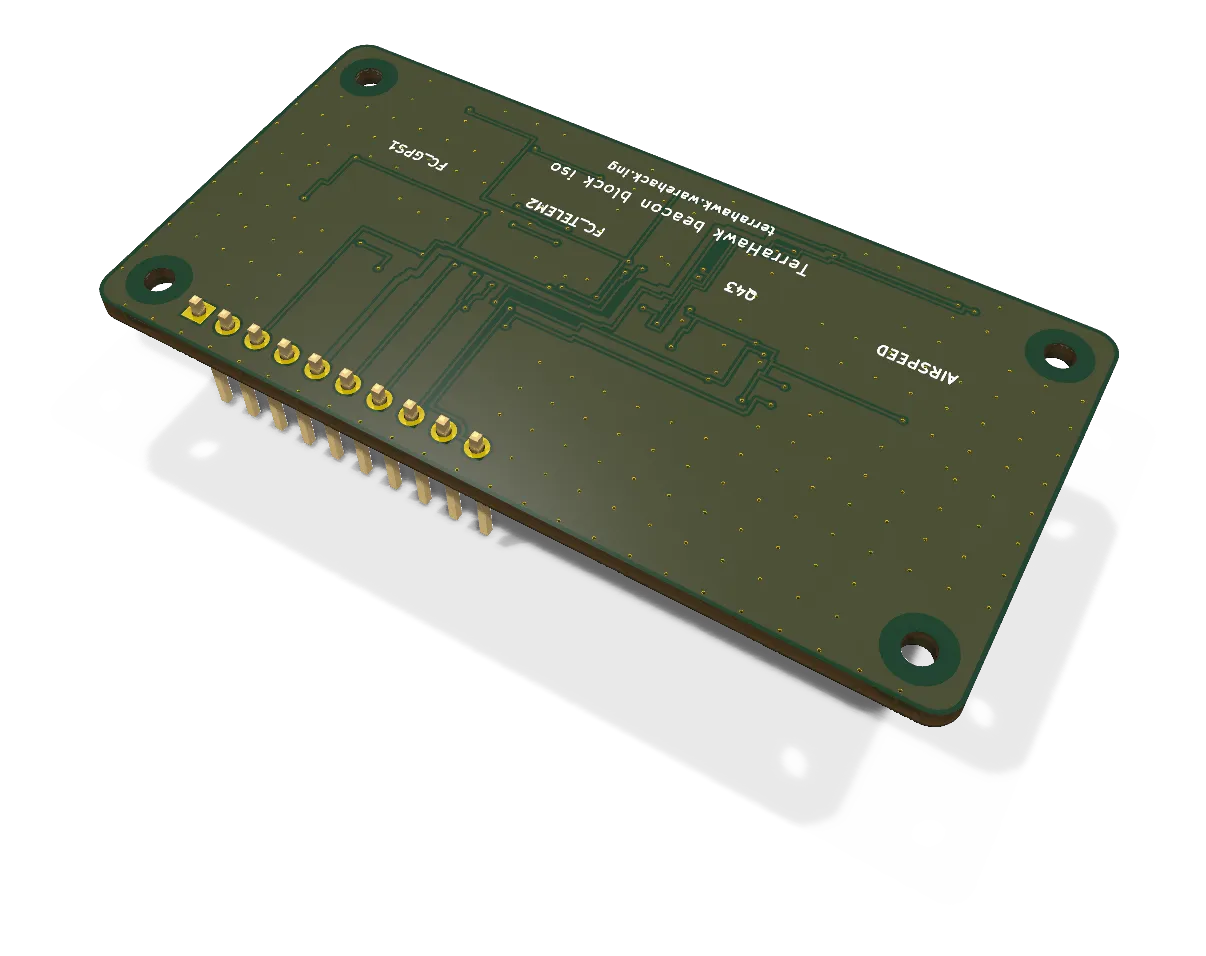
On the bench, plugged into the LUX F765 (or the Pixhawk 6C Mini) through the beacon’s own connectors: GPS1 and TELEM2 (GH-6), the airspeed tap (GH-4) and the Q43 (GH-8). The ESP32 side comes to a 10-pin 2.54 mm header, driven from a XIAO ESP32S3 kit or any 3.3 V UART. 64 x 32 mm, two layers, every part on the top face, M2 holes in the corners.
Main parts
| Part | Function |
|---|---|
| 2 x ISO7721 | Two-channel digital isolators on the GPS and radio UARTs, FC side powered by the FC |
| ISO1541 | I2C isolator on the compass lines, FC side the master |
| EL357N | Optocoupler: tells the ESP32 whether main 5 V is present |
| 74LVC1G08 | AND of the FC’s TX and the ESP32’s TX into the Q43’s RX, so either can talk to the GPS |
| J6, J7, J8, J10 | The beacon’s GPS1, TELEM2, Q43 and airspeed connectors, same parts and pin order |
Connections
| Pin | Net | Stands in for, on the beacon |
|---|---|---|
| JH1-1 | GND | the beacon’s ground |
| JH1-2 | +3V3 | the always-on 3.3 V rail (from the bench) |
| JH1-3 | +3V3_FC | the FC-side 3.3 V (from the beacon’s second regulator; on the bench, from the FC port’s 5 V through a regulator, or 3.3 V direct) |
| JH1-4 | +5V_MAIN | the main 5 V input, for the power-sense opto |
| JH1-5 | Q43_5V | the Q43’s 5 V, so a real Q43 on J8 can be fed |
| JH1-6, 7 | ESP_FC_RX, ESP_FC_TX | the ESP32’s radio-UART side of the TELEM2 isolator |
| JH1-8 | ESP_Q43_TX | the ESP32’s line into the Q43 gate |
| JH1-9 | MAIN_SENSE | the opto’s output to the ESP32 |
| JH1-10 | Q43_TX | the Q43’s TX as the ESP32 reads it |
Status
Rev A draft, 2026-10-10 (EDA 8a289ae): generated by tools/blockgen.py beacon iso --header-nets Q43_5V, 21 nets, ERC clean, routed to 0 open, DRC 0 errors and 0 warnings at every severity, every net a subset of the beacon’s. Not ordered. The bench test it exists for: with the FC side powered only by the FC and the always-on side only by the header, GPS and telemetry data cross in both directions and the compass reads; then with the FC unpowered, the always-on side keeps working and nothing back-feeds the FC.
Schematic and layout
The 3D board loads when you open this view.
Files
From the EDA repository at revision b201257 (2026-10-12). Open the files in KiCad 10 or later.
Comments
Comment on the whole page here, or on one section or step with the button beside it.