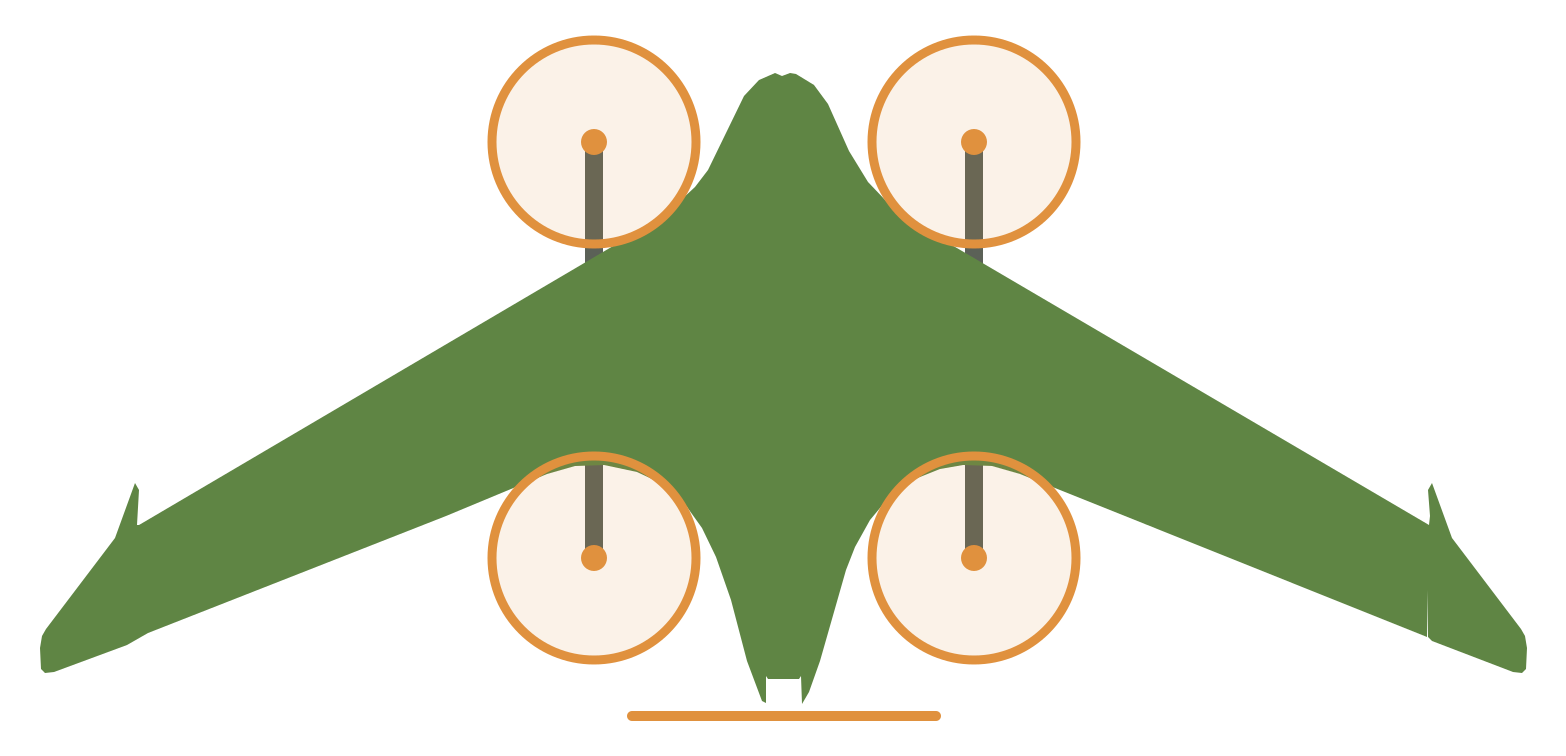
GNSS backup module
Boards / Q43 drop-in GNSS backup: Quectel LC29H(EA) L1/L5 RTK receiver, Taoglas 25 mm stacked patch with SAW and LNA, QMC5883P compass, GH-8 UART and I2C, in the Q43's envelope and seat.
The GNSS backup module replaces the Q43 if the Q43 becomes hard to get, with the same seat, envelope and lead.
- Revision
- A draft
- Sheets
- 1
- Parts
- 50
- Board
- 44 × 44 mm
- Copper layers
- 4
- Footprints
- 52
- Location
- aircraft
- Bus
- none: UART and I2C on the flight controller's GPS1 port, as the Q43 uses
- Status
- Rev A draft: routed, DRC clean (2026-10-07)
What it does
This module is a supply-risk backup for the Waveshare Q43. It is not an upgrade. The Q43 stays the plan, and this board stays a drawing and one bench unit until it is necessary.
The module is a dual-band L1/L5 RTK receiver with its own compass. A Quectel LC29H(EA) gives RTK positions at 10 Hz. A Taoglas 25 mm stacked patch receives L1 and L5. A QMC5883P is the compass, the same part as in the Q43, so the flight controller’s compass driver does not change.
Where it sits
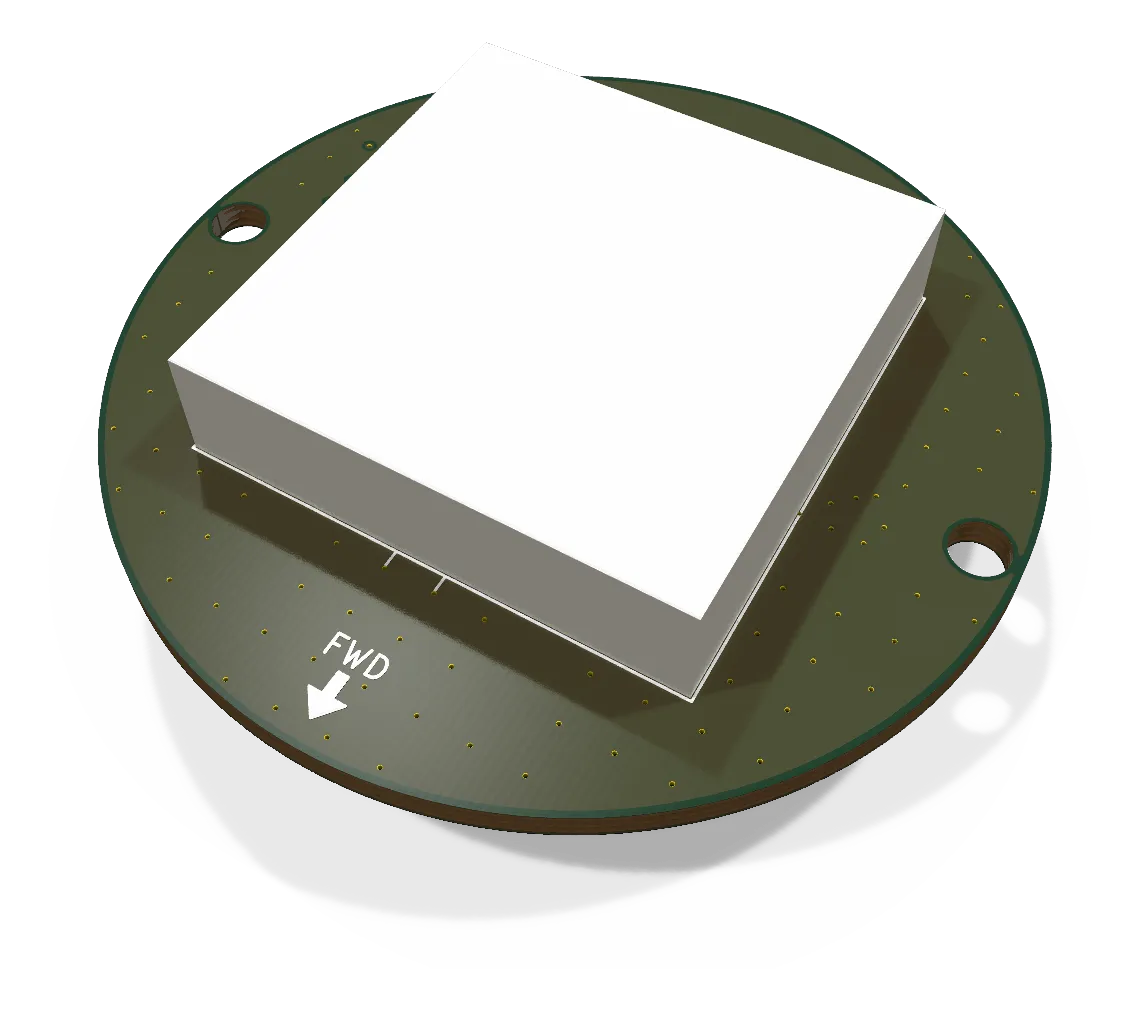
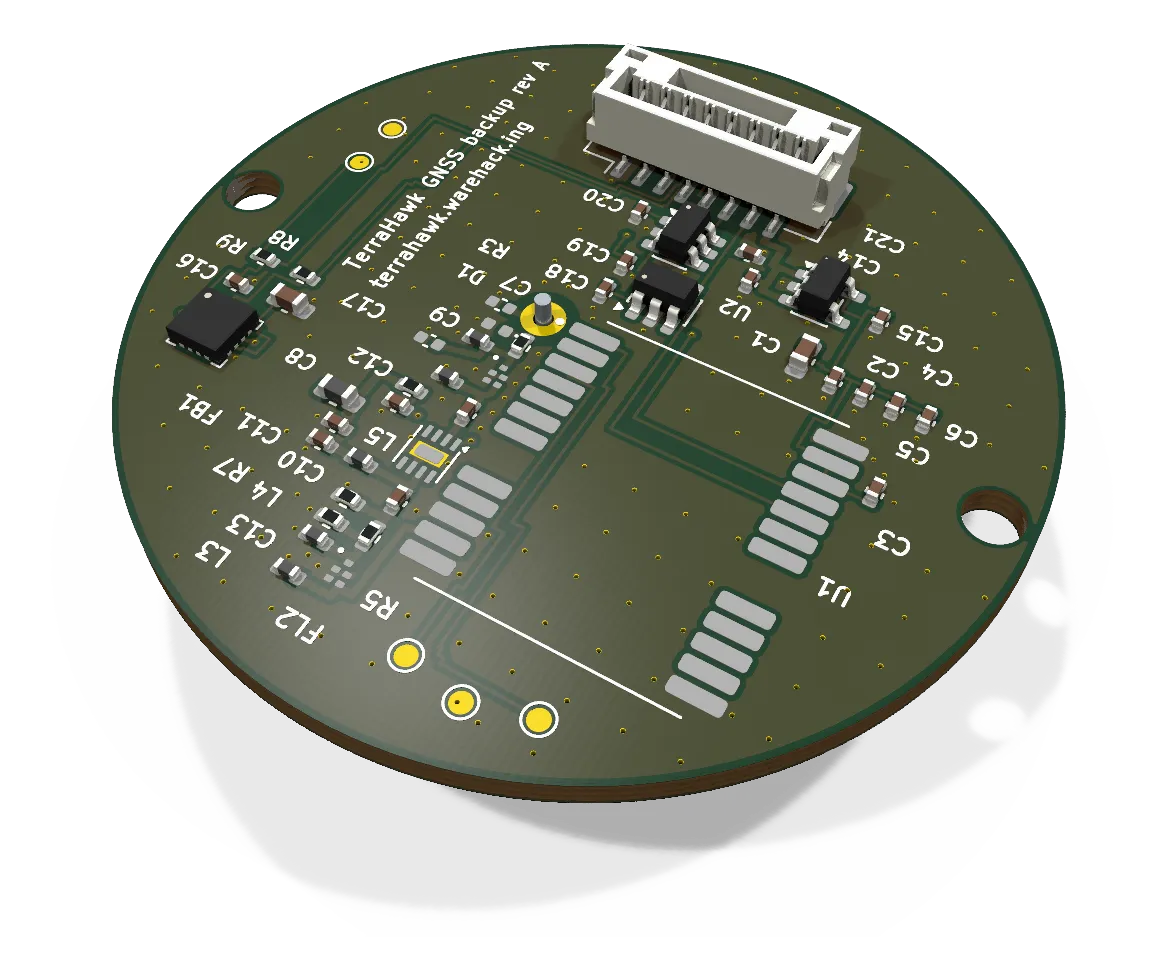
The board goes where the Q43 goes: on the Q43 seat, under the printed dome. It is a round 44 mm board, 1.6 mm FR-4 (the patch’s feed-pin land assumes 1.6 mm; ESTIMATE until the layout). Two 2.8 mm holes at 20 mm each side of the centre, on the Q43’s screw line, hold it (M2.5 inserts in the seat, ESTIMATE). The connector J1 is on the bottom face 13.4 mm from the centre, in the same place as the Q43’s connector, so the Q43’s lead and seat cutout serve both. The dome over it is th-blender’s low dome, sized to the patch stack rather than the Q43’s 37 mm height, so the module is about 32 g (ESTIMATE; the Q43 is 24 g).
The receiver sends NMEA and Quectel messages on the GPS1 port (GPS_TYPE 5). RTK corrections go in on the same port at 230,400 baud. th-avionics keeps the parameters for this module as a commented-out block in the LUX F765 file.
Main parts
| Part | Function |
|---|---|
| Quectel LC29H(EA) | L1/L5 receiver, RTK rover at 10 Hz, one UART |
| Taoglas GVLB256.A | 25 x 25 x 6 mm stacked patch, L1 and L5, 14.6 g (its datasheet’s packaging page; the table in the same datasheet says 21 g). The 8 mm GVLB258.A, 18 g, fits the same land if the L5 signal test fails |
| Two RF360 B39162B8389P810 SAW filters | One before and one after the LNA. Together they reject the 915 MHz LoRa band by 40 dB minimum |
| Qorvo QPL9547 | LNA, about 21 dB at L5 and 20 dB at L1 (ESTIMATE), on its own filtered supply |
| 3 dB pad | Keeps the total gain at the receiver under Quectel’s 17 dB limit |
| QMC5883P | Compass on the I2C lines of the GH-8, address 0x2C |
| AP2112K-3.3 | 5 V from the connector to 3.3 V for the board |
Connections
| Connector | Type | To |
|---|---|---|
| J1 | JST GH 8-pin, bottom face, the Q43’s pin order | Flight controller GPS1: 5 V, GND, UART1, I2C. The two pins for a second UART stay open, because the LC29H(EA) has only one UART. Which end is pin 1 is to VERIFY on a real Q43 |
| Test pads | 1PPS, 3V3, GND, RESET_N, WAKEUP | Bench only |
Status
Rev A draft, schematic ERC clean and the board routed on 2026-10-07 (EDA 99ed160): a round 44 mm board on four layers, three of them ground, every part on the bottom face and the patch alone on top, the RF chain laid as fixed 50 ohm copper with a via fence; DRC gives 0 errors. The LC29H’s UART runs at 2.8 V, so two SN74LVC1T45 level translators, one each way, replace the divider on its receive line; neither direction depends on the flight controller’s input thresholds (drawn and routed on 2026-10-07, EDA bb04dc3, 0 errors, 0 open). The receiver has no backup battery, by decision: each power cycle is a cold start of about 30 s (ESTIMATE) before the first fix, and RTK then converges again. Before an order, th-telemetry’s bench test compares its L5 signal strength with the Q43. The compass orientation goes to th-avionics when the layout sets it.
Schematic and layout
The 3D board loads when you open this view.
Files
From the EDA repository at revision b201257 (2026-10-12). Open the files in KiCad 10 or later.
Comments
Comment on the whole page here, or on one section or step with the button beside it.