PETG layer adhesion
Test prints / PETG: strength and fits
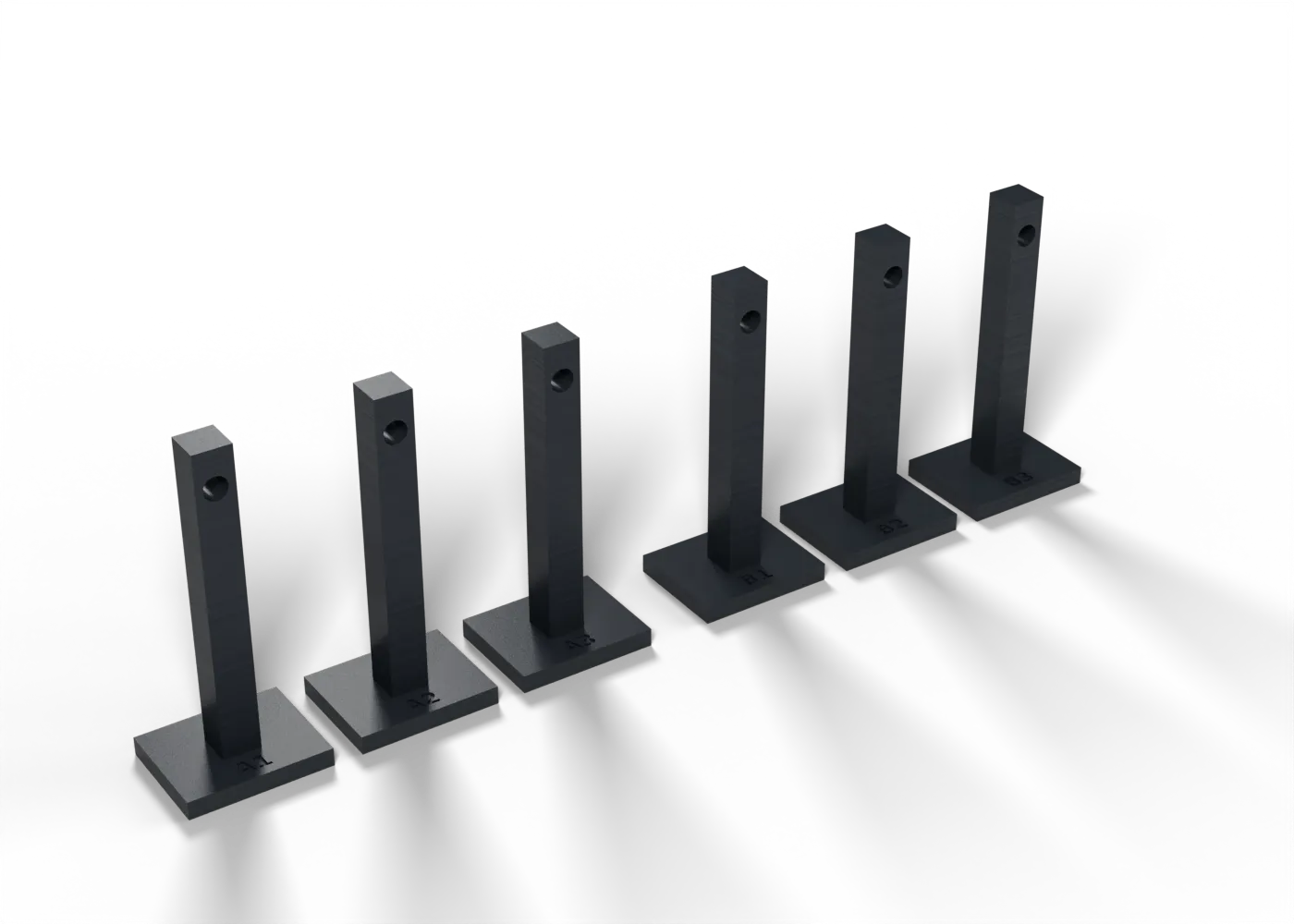
Upright bars at stock settings and with walls at 40 mm/s and 30 % fan, broken between layers.
Toolpaths
Every extrusion move in the G-code, layer by layer. Drag the layer slider, scrub through the top layer, or play the print.
Toolpaths load when you open this view.
Read from the G-code that the printer gets. The clock adds each move at its programmed speed, without acceleration or travel, so it is shorter than the slicer's estimate.
Settings
On top of the stack that the print jobs load. The printer tuning page shows that stack.
| Printer | File | Changes |
|---|---|---|
| Prusa Core One+ | A: Stock settings: the 9 s layer time slows the bar walls to about 120 mm/s; fan 30 to 60 %petg-break a (core-one-plus).bgcode | |
| Prusa Core One+ | B: Walls at 40 mm/s, fan 30 % (estimate)petg-break b (core-one-plus).bgcode | external_perimeter_speed 40perimeter_speed 80small_perimeter_speed 40bridge_fan_speed 30overhang_fan_speed_0 30overhang_fan_speed_1 30overhang_fan_speed_2 30overhang_fan_speed_3 30enable_dynamic_fan_speeds 0min_fan_speed 30max_fan_speed 30 |
Procedure
What it is for. The spar mounts and motor mounts load their layers like these bars. The test shows whether slower walls and 30 % fan bond the layers better than the stock settings.
Print. Print A (stock) and B (walls at 40 mm/s, 30 % fan). Each file has three bars, marked A1 to A3 and B1 to B3. The bars are small, so the 9 s minimum layer time slows A’s outer walls to about 120 mm/s: the test compares about 120 mm/s with 40 mm/s.
Measure. Clamp each foot and the bottom 10 mm of the bar in a vice. Hang a bucket from the hole and add water until the bar breaks; weigh the bucket.
Pass. No pass mark. Compare the means of A and B.
Record. The six masses, and where each bar broke.
In the tuning log
Comments
Comment on the whole page here, or on one section or step with the button beside it.